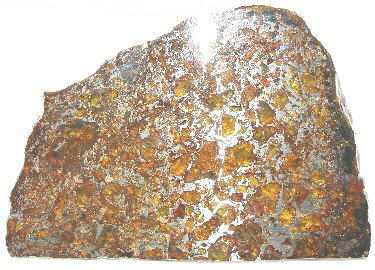
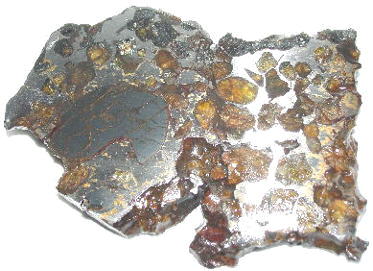
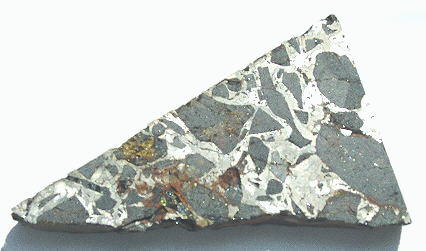
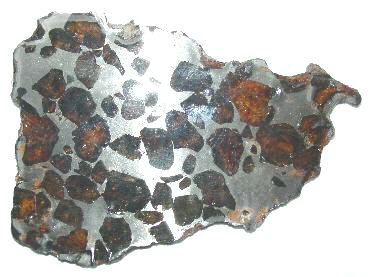
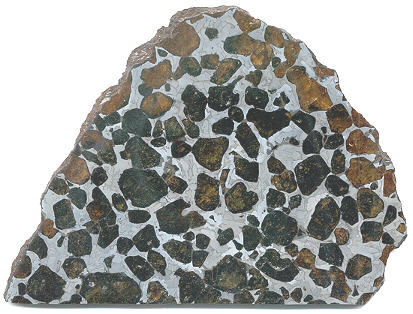
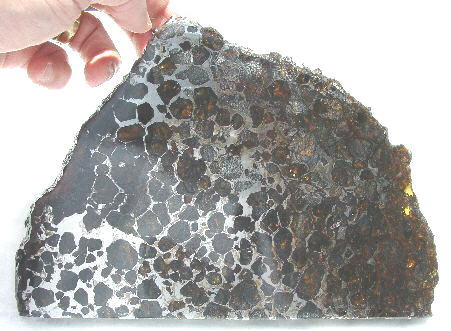
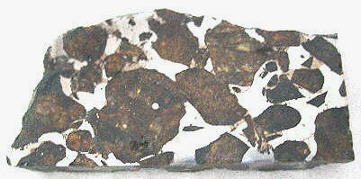
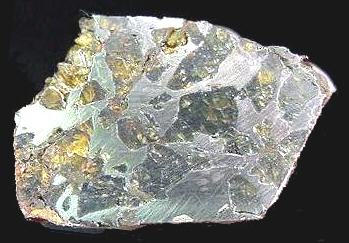
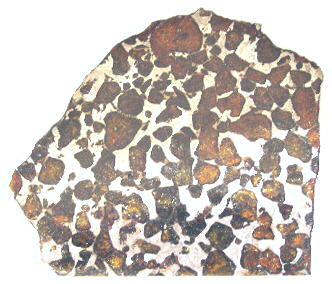
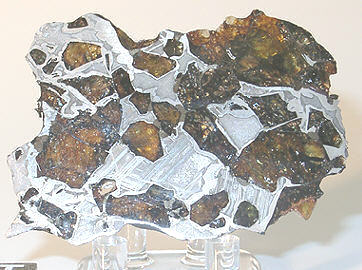
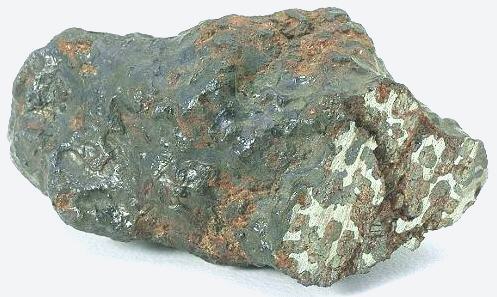
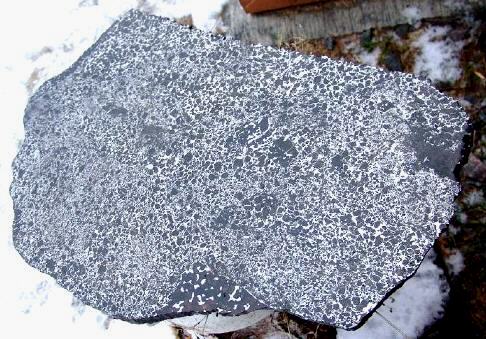
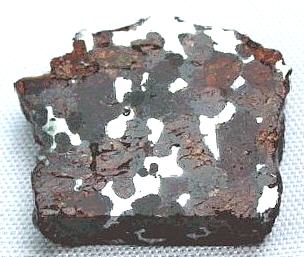
The pallasites displayed on this page are seldom represented in private collections, and some not at all. All photos are courtesy of Dr. J. Piatek.
I'd like to express my appreciation to Dr. Piatek for sharing his rare pallasite collection on meteoritestudies2.com.
Admire—PMG
Initially, a single ~6 kg pallasite was found during plowing in Kansas, USA in 1881. Subsequent recoveries increased the TKW to over 80 kg. Aptly named, Admire contains an abundance of colorful fractured and splintered olivines, and it exhibits the progressive disintegration of large polycrystalline olivine areas into smaller fragments. The photo shown above is a 400 g partial slice, acquired from the Robert Haag Collection, previously obtained from the American Meteorite Laboratory in Denver.
Molong—PMG
A single 104.3 kg pallasite was found by Thomas Farrell on his farm at Molong Creek in New South Wales, Australia in 1912. Half of the meteorite was ultimately acquired by the Australian Museum in Sydney, but the whereabouts of the other half is currently unknown. Peridot from this pallasite has been confirmed as the first to be faceted, which was done by the Lapidary Section of the Department of Mines in 1916. The photo shown above is a 103 g partial slice, acquired from the Robert Haag Collection, previously obtained from the Australian Museum.
Albin—PMG
A single 37.6 kg pallasite was found in Wyoming, USA in 1915, and recognized as a meteorite in 1935. Further masses have been recovered since then. The photo shown above is a 285 g slice, acquired from Al Mitterling Meteorites.
read more >>
Huckitta—PMG-am
A 1,084 g pallasite was found in Northern Territory, Australia in 1924. Subsequently, a larger mass of 1,411.5 kg along with over 900 kg of iron shale was found ~225 km away at Huckitta, where it had been lying for thousands of years. Most of this pallasite has been severely weathered—FeNi-metal is transformed into hematite and magnetite. Huckitta has very high Ge and Ga contents, elevated Pt, W, and Ir, and a lower Au content compared to other main-group pallasites. The photo shown above is an unoxidized 257 g partial slice, acquired in trade from the United States National Museum, Smithsonian Institution.
read more >>
South Bend—PMG
A single 2.5 kg pallasite was found during plowing in Indiana, USA in 1893. The photos above show a 126 g slice, acquired from the Robert Haag Collection, previously obtained from the Field Museum of Natural History in Chicago.
Ahumada—PMG
A 52.6 kg pallasite was found in Chihuahua, Mexico in 1909. This is a typical example of a main-group pallasite presumed to be synthesized from impact-crushed mantle olivine and residual melt from the molten core. The photo shown above is a 424 g partial slice, acquired from the Jim Strope Collection.
Mount Vernon—PMG
A 159.2 kg pallasite was found in Kentucky, USA, and recognized as a meteorite in 1902. This pallasite contains large, closely-spaced olivines with a size range of 5–25 mm in diameter. The photo shown above is a 1,507 g partial slice, acquired from the Robert Haag Collection, previously obtained in trade from the United States National Museum, Smithsonian Institution.
read more >>
Santa Rosalia—PMG
A 1,631 g pallasite was found by an Indian in Baja, Mexico, ~72 km WNW of Santa Rosalia, in the late 1940s. The pallasite was given to Pete Mahieux and then donated to H. H. Nininger for his museum, whereupon two slices were cut from the mass. Phosphate REE patterns and other data support the hypothesis that Santa Rosalia and certain other pallasites might have formed nearer the parent body surface, rather than at the core–mantle boundary. The photo above shows a 56 g partial slice, part of one of the two original slices made by Nininger. This specimen was acquired from the Robert Haag Collection, previously obtained in trade from Arizona State University, Center for Meteorite Studies.
Somervell County—PMG
Three weathered fragments having a combined weight of 11.8 kg were found in Texas, USA in 1919, but not recognized as a meteorite until 1937. In an attempt to preserve this pallasite from further deterioration, Oscar E. Monnig encased the largest piece in plastic—but it was to no avail. In the photo above is a 51 g partial slice in relatively uncorrupted condition, acquired from the Rob Elliott Collection, previously obtained from Texas Christian University.
Quijingue—PMG
In 1984, while digging holes in which to plant trees for a fence row, a farmer in Bahia, Brazil uncovered a 59 kg pallasite. A second mass with a weight of 32 kg may have also been found. The farmer's son gave the meteorite to a miner for use as an anvil, and a portion was eventually sent to the National Museum in Rio de Janeiro for identification. Quijingue is a main group pallasite that contains 72% olivine. The photo shown above is a 307 g partial slice, acquired from the Robert Haag Collection.
Pavlodar—PMG-am
A mass weighing 4.5 kg was found in 1885 near the village of Jamysheva in the former USSR. Pavlodar contains a high volume of rounded silicates having a high Mn content. It has by far the lowest Au content in metal of any other pallasite, as well as the second highest Ir content. Because of its very anomalous composition, it's been suggested that it formed in a unique environment on the PMG parent body (Wasson and Choi, 2003). The photo above shows a 272 g partial slice, acquired from the Field Museum of Natural History in Chicago.
NWA 2397—PMG
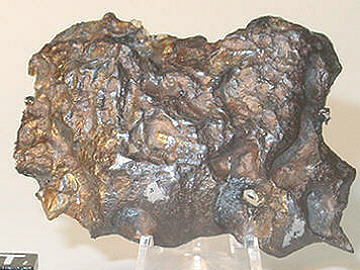
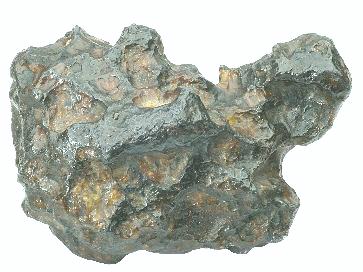
A single mass weighing 362 g was found in 1997 in Morocco. The meteorite was purchased in 1999 by a collector, and only a few sections have been distributed to date. The fayalite value of this beautiful pallasite was determined by Northern Arizona University to be ~12, which indicates that this is a main-group member. The two top photos show both sides of a 74.2 g end section cut from the main mass, which itself is shown in the bottom photo (photos not shown to the same scale).
As reported by Mednikov (1967) and others, a large mass was found in a stream bed of the Yasachnaya River by a geologist in the Magadan Region of the USSR (V. Buchwald, 1975). The triangular-shaped mass weighed 272.3 kg. A further search of the area resulted in the recovery of an additional 51 kg mass. The iron meteorite was initially classified by J. Wasson (1974) as a member of chemical group IIE, but more precise elemental analyses of the IIE iron group by J. Wasson and J. Wang (1986) determined that Seymchan was not a typical IIE group member and was reclassified as an ungrouped iron. New masses recovered very recently were found to contain silicates with a pallasitic texture, and new data indicate that this is a main-group pallasite (J. Wasson). Notably, Seymchan does have an anomalously high Ir content (van Niekerk et al., 2007). The specimen shown above is a 7,160 g pallasitic slice of Seymchan. read more >>
NWA 1911—pyroxene-rich
A fresh complete stone, weighing 53.07 g, was recognized by Mike Farmer in a batch of meteorites shipped to him from Rissani, Morocco in March 2003. Northwest Africa 1911 was found to have a modal composition of 24.3% FeNi-metal and 75% silicates, with the silicates consisting of 34.5% orthopyroxene and 40.2% olivine—the highest pyroxene content recorded for a pallasite. Only three meteorites having pallasite-like compositions were recognized prior to the discovery of NWA 1911—Vermillion, Y-8451, and Zinder. The O-isotopic compositions of all four meteorites are distinct from each other, with only NWA 1911 plotting within the field of the main group pallasites. Boesenberg and Humayun (2019) demonstrated that NWA 1911 and Zinder are related. The specimen shown above is a 6.7 g slice of NWA 1911, acquired originally from M. Farmer. read more >>