Based on Sm–Nd and Rb–Sr data, ALH 84001 appears to have the oldest crystallization age of all martian meteorites at 4.470 (+0.035/–0.026) b.y. (Nyquist and Shih, 2013). However, calculations made by others utilizing the U–Pb and Pb–Pb isotopic systems defined a younger combined mineral age of 4.117 (±0.016) b.y., consistent also with the maskelynite Ar–Ar age (4.163 [±0.035] b.y.) and the Lu–Hf age; this is probably also the time of acquisition of the natural remanent magnetization component that is observed in the meteorite. A Lu–Hf age determination by Righter et al. (2009) resulted in a young crystallization age of 4.086 (±0.030) b.y., and an age derived by Lapen et al. (2010) reflects an age of 4.091 (±0.030) b.y. Reportedly, the Lu–Hf system is less subject to alteration by water, shock, and heat than the Sm–Nd system, and is thought to accurately reflect the crystallization of cumulate orthopyroxene derived from an LREE-enriched, late-stage parental source magma. This younger crystallization age may be associated with the Late Heavy Bombardment period of the Solar System. Contrariwise, Nyquist and Shih (2013) consider the Sm–Nd radiometric system to be the more robust of the two, and they argue that it was the Lu–Hf age that reflects a resetting event.
Various radiometric dating systems indicate a younger carbonate formation age of 3.9–4.0 b.y., while a Th–Pb isochron at 2.9 b.y. attests to the late addition of Th to the ALH 84001 lithology, likely through metasomatic processes by a phosphate-rich liquid (Jagoutz et al., 2009; Albarède et al., 2009). The 4.12 b.y. crystallization age is consistent with that of a large number of enriched shergottites, including Zagami, Shergotty, RBT 04262, and NWA 1068, thought to be derived from a late-stage incompatible-element-rich residual liquid. Notably, strong similarities exist for the high Hf/Sm and Zr/Sm ratios and the trace element patterns among these enriched shergottites and ALH 84001 (Barrat and Bollinger, 2010). Furthermore, the similar values for ε142Nd and ε182W, and the Lu/Hf and U/Pb ratios, reflect a close affinity between shergottites and ALH 84001 and raise the possibility of a shergottite precursor. Another isochron observed at 4.3 b.y. is the same as another grouping of shergottites, including QUE 94201 and NWA 1195.
ALH 84001 consists of 97% cumulate, coarse-grained, magnesian orthopyroxene. The rock is thought to have crystallized at low pressure (<0.5 GPa) at a depth of several tens of km under slightly reducing conditions (QFM –2.7), and under the influence of carbon buffering (Righter et al., 2008). It is considered likely to be a sample from the 4+ b.y. old southern hemisphere of Mars, rather than the younger, lava-covered, northern hemisphere. Alternatively, a rayed crater 6.9 km in diameter named Gratteri, located near Memnonia Fossae southwest of the Tharsis volcano, could be the source of ALH 84001 (Tornabene et al., 2006). This crater, exhibiting more than 30 rays having lengths up to 595 km, was formed by an oblique impact ~20 m.y. ago. The impact excavated Noachian-aged rock (a period extending from the birth of Mars to ~3.5 b.y. ago) is consistent with the ancient age of ALH 84001. Based on data from the Infrared Mineralogical Mapping Spectrometer aboard the Mars Express orbiter, orthopyroxene-rich terrain of appropriate Noachian age has only been identified in regions of Syrtis Major and in the northwest region of Hellas basin (Ody et al., 2013).
Following the formation of carbonate and maskelynite, a rapid, localized, high-temperature (>1400°C) shock event occurred 1.158 (±0.110) b.y. ago (Cassata et al., 2010). From models of the time period following this localized event, temperatures for the ALH 84001 rock were maintained at either ~80°C for 10 m.y. if residing under an ejecta blanket, or ~330°C for several days if residing near the surface (Cassata et al., 2010). Remagnetization occurred during this shock heating event, causing the heterogeneous pattern of magnetization observed. Following the ejection of the rock from Mars ~12 m.y. ago, temperatures were calculated to be a maximum ~75°C or ~320°C, corresponding to a duration of 10 m.y. and several days, respectively.
A shock metamorphic event is recorded in the U–Th–Pb age of the phosphates, in the Ar–Ar shock age from maskelynite, and in other isochrons, each indicating an age of ~4.0 m.y (Terada et al., 2003). Treiman (1998) determined that ALH 84001 experienced 4–5 separate impact events. During the third impact event, which succeeded carbonate formation, the rock experienced its greatest heating, increasing to a temperature of at least 529°C, and perhaps as high as 800–900°C; the latter high temperature is consistent with the feldspathic melts present in the rock (Domeneghetti et al., 2007). The maskelynite has a refractive index that corresponds to a shock pressure of 32 (±1) GPa (Fritz et al., 2005). It may be presumed that during this significant impact event, the rock was launched into a suborbital trajectory and then covered by an ejecta blanket after landing. It is likely that this is the period when the Fe-rich carbonate globules were decomposed to fine-grained, whisker-shaped magnetite.
The rock was then rapidly cooled over a short duration of time, probably measured in minutes for a rock situated very close to the surface, preserving the carbonate and the observed chemical zoning. Thereafter, a cooling rate of ~35°C/year was established, as indicated by the orthopyroxene geospeedometer (Domeneghetti et al., 2007). At a depth of ~6 m, cooling proceeded over the next couple of hundred years. During one or two subsequent impact events, a post-shock temperature increase of 100–110°C (to at most 350–500°C) was attained, after which the ALH 84001 lithological unit did not experience high metamorphic temperatures again, not even during its subsequent ejection from the planet.
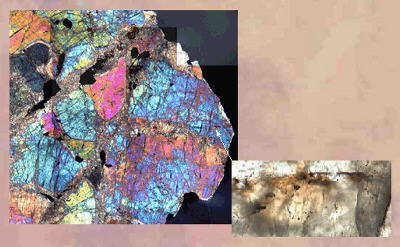
Recently, thermal emission spectrometry performed by the Mars Global Surveyor has located a region in Eos Chasma that contains orthopyroxene compositionally similar to that in ALH 84001, hinting at a possible point of origin. Within the orthopyroxene, mm- to cm-wide crushed and annealed fracture zones are present, indicating that this meteorite was subjected to an intense, localized shock event of short duration after it was cooled in an igneous plutonic environment. No evidence of subsequent metamorphism was observed. The fracture zones contain µm- to sub-µm-sized angular, rounded, and euhedral chromite grains; some appear to be stringers of shock-dispersed larger grains, while others likely exsolved from a Cr-rich melt phase. In addition, orange-colored, rosette-, slab-, or disk-shaped carbonate inclusions are present, some of which have rims consisting of two Fe-rich black zones sandwiching a white Mg-rich zone.
These chromites and carbonates are thought to have precipitated ~4 b.y. ago from a heated, shock mobilized solution, consistent with the observed chemical heterogeneities and microstructures (Barber and Scott, 2006). However, other investigators believe the larger carbonates precipitated from a low-temperature, saturated solution. In support of a low temperature environment for carbonate formation, Theis et al. (2008) constrained the temperature of carbonate precipitation to 83°C (±67°C), based on the degree of Fe isotope fractionation affecting the zoned carbonates relative to the Fe isotopic composition of martian silicates with which they were initially in equilibrium. Nucleation or redistribution of these phases occurred within these impact-generated fracture zones, with the slab-shaped carbonates relegated to formation within the larger fractures. Various minerals were subsequently deposited upon these carbonates, which are designated "magnesite–siderite–magnesite" layers and "post-slab magnesites", while chromium oxide (eskolaite) was deposited on rare silica glass. The final phase in the post-shock assimilation sequence was the mobilization of molten feldspathic glass (Corrigan, 2004) and phosphate.
Usui et al. (2016) conducted a H,C,O-isotopic study of the carbonates in ALH 84001. They obtained a more precise range for the δD value of ~500–1,000‰; this value represents the H-isotopic composition of the water reservoir during carbonate formation in the Noachian period. In addition, they ascertained that the H-isotopic composition is positively correlated with the C- and O-isotopic compositions.
Nuclear track data suggest that ALH 84001 had a pre-atmospheric radius of ~10 cm, and suffered atmospheric ablation of over 85%. Among martian meteorites, ALH 84001 has the oldest cosmic-ray exposure age of 14.7 (±0.9) m.y. It has a terrestrial age of ~13,000 years, but spent less than 500 of those years exposed on the surface of the Antarctic icefields, consistent with its low terrestrial weathering effects.
In a paper published in Science, McKay et al. (1996) presented evidence of possible biogenic activity on early Mars that was found in this martian meteorite. The evidence supporting their theory included the following:
According to some, an important constraint on this theory is the extremely small size of the proposed organisms, thought to be below the size needed to contain the framework of a living organism. Recently however, nanobacteria in the 50 nm size-range, with shapes resembling those found in ALH 84001, were cultured in the lab. Results of tests for DNA and cell walls were positive. Similar microfossil-like features have also been found in the Nakhla and Shergotty meteorites.
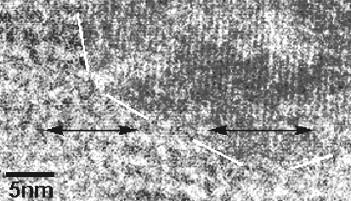
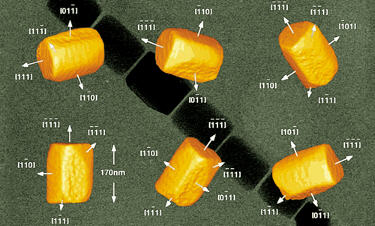
Magnetite particles extracted from carbonate globules in ALH 84001 have been characterized as irregular, prismatic, or whisker-like. The prismatic magnetites (see image below) were found to be indistinguishable from terrestrial magnetites produced by the bacteria strain MV-1 in several properties that are not associated with inorganic magnetites. Rather, these properties, regarding attributes of size, morphology, and chemistry, are uniquely characteristic of biogenic bacteria. Therefore, this particular type of magnetite may be interpreted as having a biogenic origin. In contrast, an inorganic process involving the thermal decomposition of siderite has been proposed as the source of the single-domain magnetites, which M. S. Bell (2017) has experimentally demonstrated under shock conditions of 49 GPa and temperatures >470°C.
Other researchers have investigated the distribution of PAHs by studying them in the martian meteorite EET 79001. This meteorite has a far younger formation age of 180 m.y., and as such, formed after the surface of Mars became devoid of water. In addition, analyses of PAHs from a carbonaceous meteorite that was recovered near ALH 84001, and of PAHs from Antarctic ice meltwater, have revealed that all of these sources of PAHs were similar. This study suggests that these sources probably reflect thousands of years of contamination from terrestrial or extraterrestrial PAHs that are present in the Antarctic ice. In support of the contamination theory, results of a time-of-flight secondary ion mass spectrometry (TOF-SIMS) analysis revealed a correlation exists between the PAHs and terrestrial lead (Stephan et al., 2003). This study also demonstrated that there is no spatial association between the PAHs and the carbonate globules as previously claimed. Moreover, the effects of oxidation from Antarctic weathering on the PAHs, resulting in a reduced alkylation, can be readily explained without reference to possible fossil martian life. Studies of other biomarkers of biologic activity including carbon, oxygen, and sulfur isotopes, suggest that they reflect cycling through the martian atmosphere or terrestrial contamination, and are not indicative of production through any biological system.
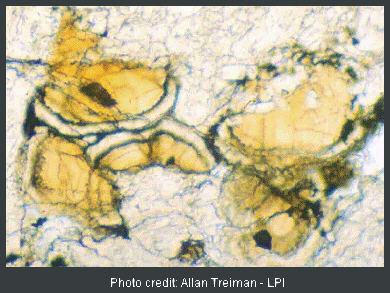
Recent observations of the formation history of ALH 84001 point to a complex history of impact deformation, metamorphism, and chemical change, which places further constraints on the presence of biogenic fossils. In the beginning, crystallization of a basaltic magma containing ~2.5–5% interstitial melt was followed by contractive deformation and chemical equilibration. A period of aqueous alteration and dehydration of orthopyroxene, resulting in the production of olivine, may have also occurred. Following next was a series of deformations and intense thermal metamorphism, which produced and annealed, respectively, the granular bands. This suggests ALH 84001 was part of a large crater basement in which multiple compression and rarefaction shock waves, approaching 75 gigapascals (GPa), affected the rock. Afterwards, a shock event, with pressures of at least 30 GPa, created fractures that cut across the granular bands and formed feldspathic glass. The next event to occur was the deposition of zoned carbonates (having the morphology of an inverted conic frustum) in the fractures within the granular bands replacing the feldspathic glass (see following photo). A third impact deformation event of ~60 GPa fragmented the carbonate globules and injected melt veins of feldspathic glass into the globules. Evidence for a forth deformation event is also present. This event has reorientated the fragments surrounding a series of fractures, resulting in different magnetic signatures. This event could also represent the launch of ALH 84001 from Mars ~12 m.y. ago.