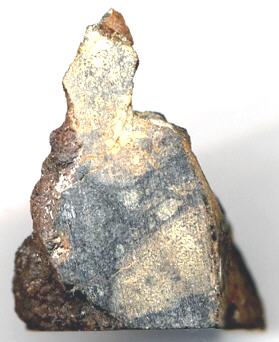
Bison is an LL6 chondrite with a monomict composition of dark-colored, unmelted clasts containing highly shocked, relict chondrules, along with light-colored impact-melt breccia clasts devoid of chondrules, all embedded within an opaque, blackened host rock. This blackening is primarily the result of shock-induced microscopic troilite inclusions and veinlets interspersed throughout the matrix. The poikilitic texture, depletion of metal and sulfides, and high CaO content in orthopyroxene present in the light-colored clasts of Bison are all consistent with a rapid crystallization from a melt (Dominik and Bussy, 1994). A two-stage shock history has been suggested: 1) the first impact caused localized impact melting and brecciation; and 2) a subsequent impact produced features of shock stage S4. In an Ar–Ar dating study of two LL chondrites, Weirich et al. (2009) determined an age of ~1 b.y., possibly reflecting the last major impact on the LL chondrite parent body.
Bison has experienced a low degree of weathering. Shown above is a 13.79 g partial end section of Bison exhibiting a brecciated structure.