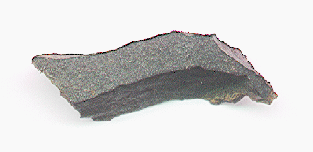
Although the S(IV)-type asteroid 6 Hebe has been considered as a probable candidate for the parent body of the H-type ordinary chondrites, hydrocode models show inconsistencies exist between expected and observed CRE ages based on the scenario of direct injection into resonances. The steady delivery of H chondrite material from 6 Hebe to Earth also remains unexplained. Current studies by Rubin and Bottke (2009) have led to the conclusion that family-forming events resulting in large meteoroid reservoirs, which have homogeneous compositions and locations near dynamical resonances such as the Jupiter 3:1 mean motion resonance, are the likely source of the most prevalent falls including H chondrites and HED achondrites (especially howardites). As a matter of fact, a number of asteroids having H-like mineralogies have been observed near the 3:1 (2.50 AU) and 5:2 (~2.82 AU) resonances (Burbine et al., 2015 and references therein). See further details on the Abbott page.
Due in part to the intense temperature and moisture conditions in the state of Florida, only four meteorites have been found there to date, in addition to two recovered falls. Besides Bonita Springs, approximately 1 kg of L4 fragments were brought up in a net offshore of Lake Okechobee, a 502 g, H4 stone was plowed up in Eustis, and a 10.9 kg H5 stone was found near Grayton Beach. In 2004, November 8 at 6:15 P.M., Orlando resident Donna Shuford heard a meteorite bounce off her car and hit the side of her house. Fragments composing an ~180 g eucrite were recovered. In 2016, January 24 at 10:27 A.M., numerous eyewitnesses observed a bright fireball over northern Florida near the Osceola National Forest. Utilizing radar images from several stations, a group of hunters successfully plotted the fall site and recovered 8 stones over many weeks having a combined weight of 1,099.6 g. The L6 chondrite fell within a forested wetlands region delimiting a strewn field of approximately 5 miles × 1 mile.