Iron, IIIF, medium octahedrite
Clark County grouplet
click on image for a magnified view
Recognized 1937
38° 0' N., 84° 10' W.
(coordinates reflect recovery in Winchester, Clark, Kentucky, USA)
An iron meteorite weighing 11.3 kg was recovered in 1937 with the assistance of J.D. Figgins, Director of the Bernheim Museum (now the Denver Museum of Nature & Science) (Vagn F. Buchwald, 1975). The iron mass was reportedly found in southern Clark County and had been in the possesion of a Lexington resident for a number of years. After Mr. Figgins acquired the meteorite, he exchanged most of it with H.H. Nininger at the American Meteorite Laboratory. Apparently both N.N. Nininger and D.M. Young wrote descriptions for Clark County in 1939, the latter of which, titled 'Three new siderites from Kentucky: Campbellsville, Clark County, and Providence', can be found in the MAPS archive vol. 2, #5, pp. 121–124, January 1939.
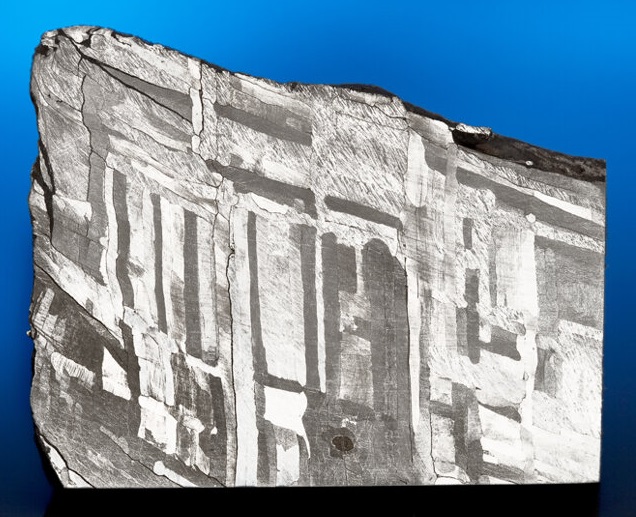
The Clark County iron meteorite originally had a flattened ellipsoid shape measuring about 19 × 19 × 10 cm (Vagn F. Buchwald, 1975). It has been severely coroded after spending an estimated 600,000 years on Earth, as determined by Chang and Wänke (1969) using Be–Cl chronometry. Several millimeters of oxidized iron were present on the surface, and pervasive limonite veins have intruded the medium Thomson (Widmanstätten) structure.
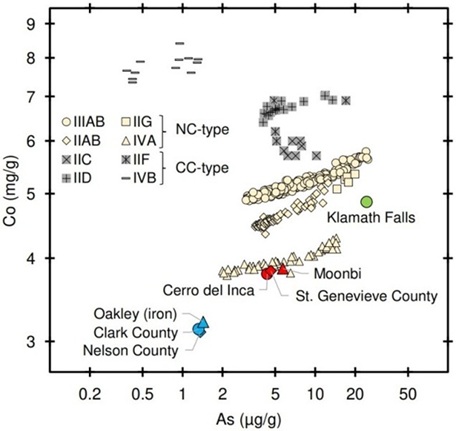
Neither the variability in the structural class (including fine, medium, coarse, and very coarse) nor the interelement trends (e.g., Ga–As, Ge–As, Co–As, Au–As) for the IIIF irons are consistent with a simple core fractional-crystallization model, which led Zhang et al. (2022) to propose a division into two grouplets: (1) Moonbi grouplet (Moonbi, Cerro del Inca, and St. Genevieve County), and (2) Clark County grouplet (Clark County, Nelson County, and Oakley (iron), with Klamath Falls potentially crystallizing from a separate parental metallic melt. This division is clearly demonstrated in their interelement diagrams of Fig. 4A–D, Fig. 5A–R, and Fig. 6, the latter of which is shown below.
Co vs. As Trend for Group IIIF and Other Magmatic Irons
Diagram credit: Zhang et al., GCA, vol. 323, fig. 6 (2022, open accesslink
'Chemical study of group IIIF iron meteorites and the potentially related pallasites Zinder and Northwest Africa 1911'
(https://doi.org/10.1016/j.gca.2022.02.004)
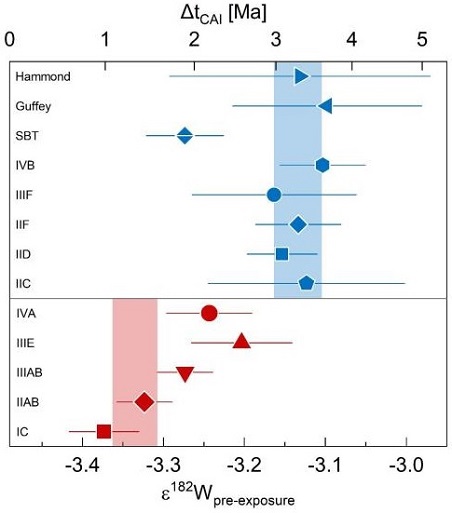
Interestingly, Rubin (2018, Fig. 1) has shown that group IIIF irons are poorly resolved from the NC-iron groups with respect to Ni and Ir contents. Acquisition of stable isotope data (Mo, Ru, and W) for these pallasites and other IIIF irons is in progress to ascertain their correct protoplanetary reservoir and to further evaluate any genetic connections that may exist. Thus far, Pape et al. (2022 #6478) has reported results for ε182W values of the IIIF members obtained after correcting for CRE-induced W isotope variations. The results establish a Hf–W model age for the IIIF parent body of ~2.2 m.y. after CAIs, which is older than the previous age of 3.0 (±1.2) m.y. after CAIs calculated from less inclusive data. This revised IIIF differentiation age is now the oldest among CC irons (excluding the South Byron Trio) and about the same as the IVA group among NC irons calculated at 2.2 (±0.2) m.y. after CAIs (Spitzer et al., 2021; see diagram below and data chart). Molybdenum isotope data will become available soon.
Hf–W Ages Corrected for Nucleosynthetic Pt Isotope Anomalies
Note: the IIIF age indicated below is prior to the revised age of ~2.2 m.y. after CAIs
Diagram credit: Spitzer et al.EPSL vol. 576, art. 117211 (2021, open accesslink)
'Nucleosynthetic Pt isotope anomalies and the Hf-W chronology of core formation in inner and outer solar system planetesimals'
(https://doi.org/10.1016/j.epsl.2021.117211)
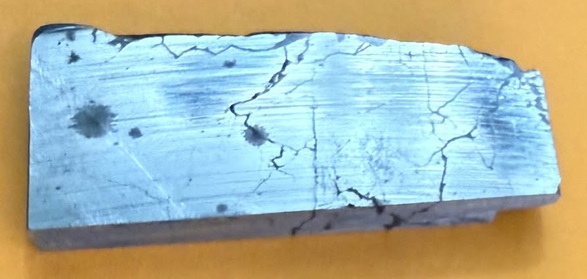
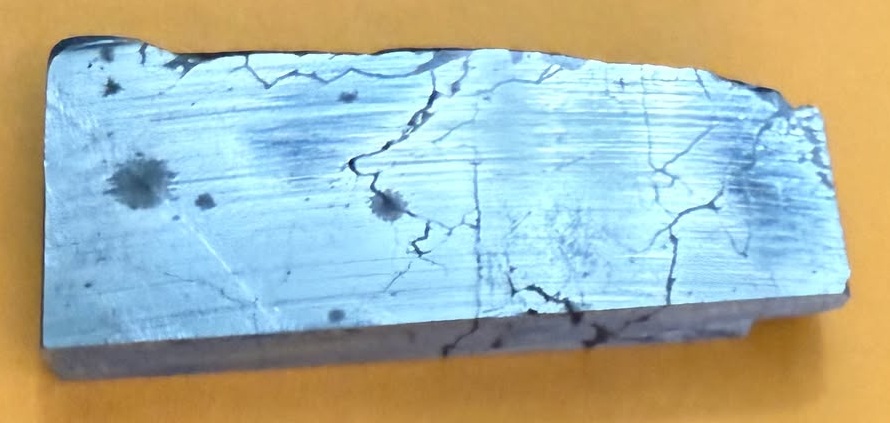
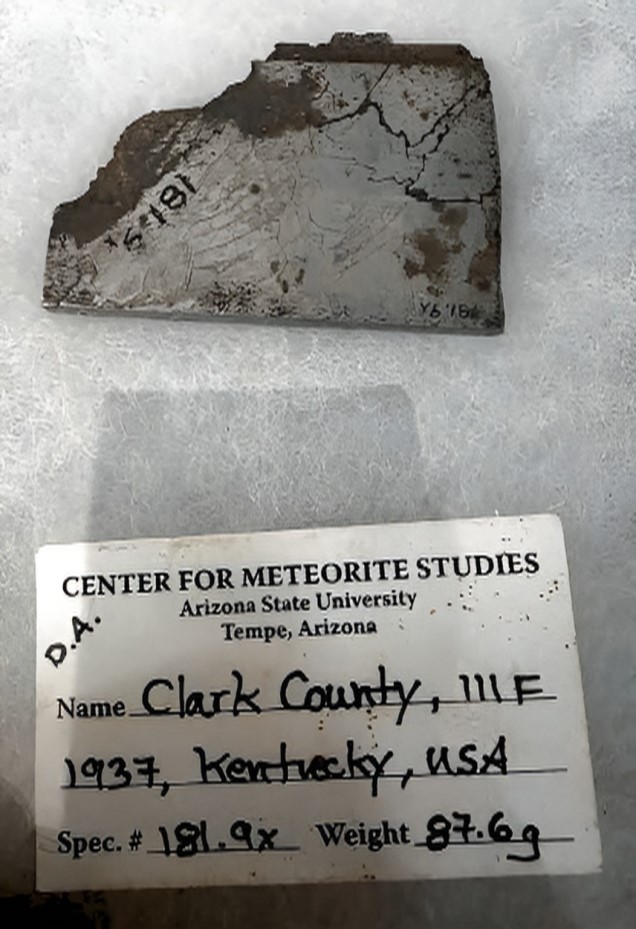
See the St. Genevieve page for further details about the IIIF group irons. The specimen of Clark County shown above is a 24.02 g partial slice sectioned from an 87.6 g part slice which was deaccessioned from Arizona State University for M. Lyon (see top photo below). Continuous Neumann bands can be seen on this well-prepared specimen (C. Zlimen), which attest to one or more impact shock events experienced during its space journey. The bottom photo below shows a 77.73 g etched slice of Clark County that was sold in 2012 through Heritage Auctions.