Chondrite, type 3.5-ungrouped
Found April 1996
28° 36.21' N., 13° 18.04' E.
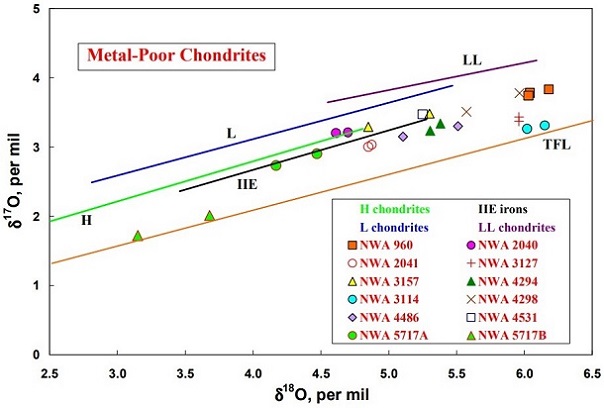
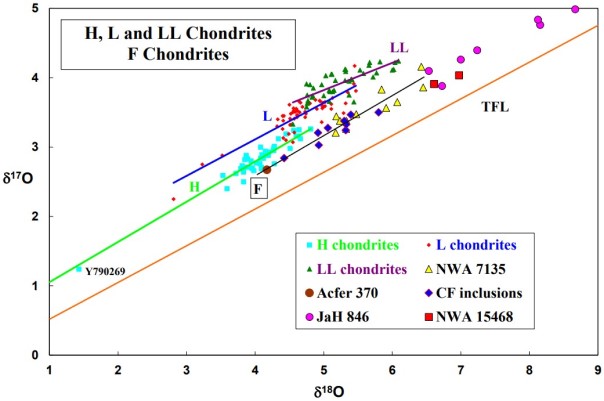
Six pieces of this highly unequilibrated meteorite were recovered in Ash Shati', Libya, having a total combined weight of 936 g. The oxygen three-isotope diagram for HaH 180 (constructed by Achim Raphael from published data) has values that plot slightly above the TFL and within a field occupied by a small number of anomalous, ungrouped, non-carbonaceous chondrites, including JaH 846, NWA 960, NWA 2335, and NWA 2336, along with the members of the F chondrite group. Taken together with the NWA-series meteorites 2040 [LL], 2041 [L], 3114 [L], 3127 [LL], 3157 [L], 4294 [LL], 4298 [LL], 4486 [L], 4531 [LL], 5717 [dual lith], NWA 7835 [acho-ung; Irving et al., 2014, #5332; photo courtesy of Stefan Ralew], and NWA 10769 [acho-ung; Moggi Cecchi et al., 2017, #2696], and NWA 15468, these O-isotopic values infer a possible "supra-TFL" genetic grouping which defines a slope distinct from the ordinary chondrites. As demonstrated in the diagrams below, these meteorites plot far away from the trend lines for the H, L, and LL ordinary chondrite groups and probably represent several previously unrecognized parent asteroids (Irving et al., 2014, #5332).
Diagram credit: Rumble III et al., 38th LPSC, #2230 (2007)
Diagram credit: Bunch et al., 41st LPSC, #1280 (2010)
Diagram credit: Irving et al., 54th LPSC, #2309 (2023)
'Evidence For A Previously Unrecognized Non-Carbonaceous Chondritic Parent Body From Petrologic And Oxygen Isotope Studies Of Ungrouped MG-Rich Chondrite Northwest Africa 15468'
The mineralogy of HaH 180 consists of olivine and Fe-rich pyroxene and excludes a relationship with E chondrites. This meteorite is very weakly shocked to stage S2 and highly weathered to grade W4. Studies of the bulk chemical and mineral composition and petrographic features of both HaH 180 and the similar Deakin 001 suggest an affinity to LL-group chondrites. The anomalously high 18O compositions could be explained by unusually high terrestrial weathering effects, or that these unequilibrated ordinary chondrites sample a wider range of oxygen isotope compositions than previously identified. On the other hand, these meteorites might represent a unique chondritic parent body. Interestingly, a dark inclusion found in the LL3.3 chondrite Wells has an O-isotope composition that plots close to HaH 180, as does a silica-rich orthopyroxenite inclusion found in the L3 chondrite Bovedy.
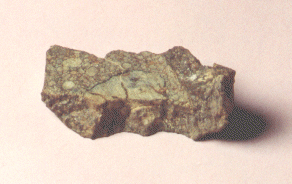
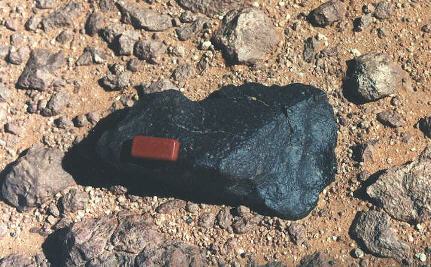
The HaH 180 specimen shown above is a 5.5 g cut fragment exhibiting a characteristic large, rounded, dark-rimmed, lithic clast. Below is an in situ photo of HaH 180, its persistent dark appearance belying a long terrestrial residence. A high-resolution photo of a 7.73 g full slice of one of the smaller HaH 180 fragments is an exquisite sight.