Pyroxene pallasite, ungrouped
click on photo for a magnified view
Purchased 2021
28° 37' 42" N., 4° 43' 39" E.
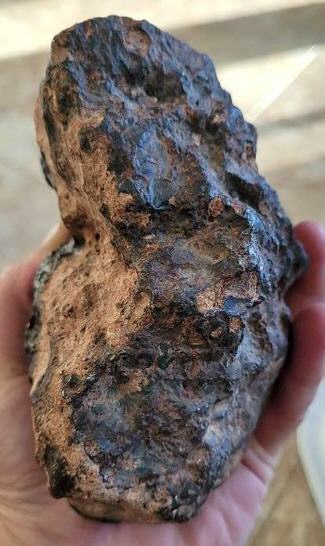
Five individual masses with a combined weight of 10 kg were found in Algeria near the southwest tip of Ouargla Province in the northeast corner of In Salah Province (Google Earth image), and these were subsequently purchased by M. Lyon. A type sample was submitted to the University of New Mexico's Institute of Meteoritics for analysis and classification (A. Ross and C. Agee; K. Ziegler, oxygen isotopes), and Hassi el Biod 002 was classified as an ungrouped pallasite.
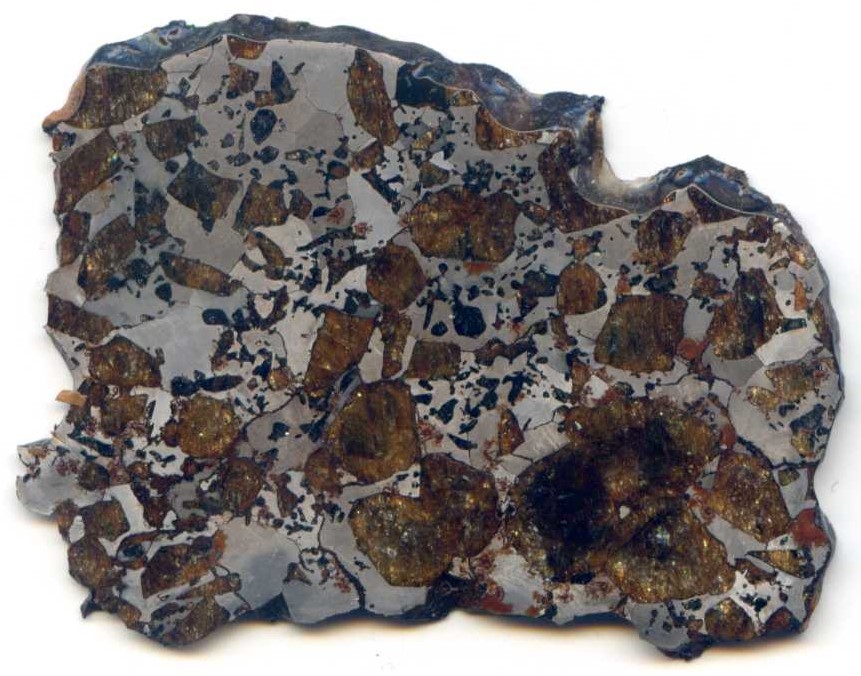
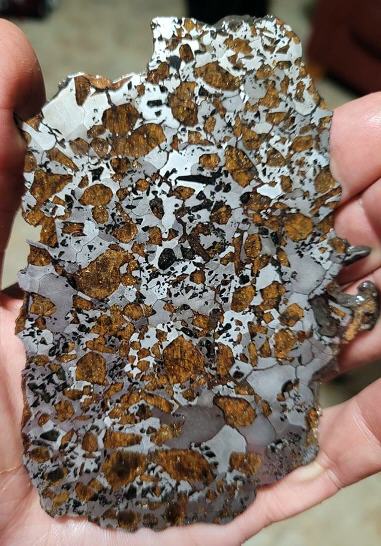
The HeB 002 pallasite is composed of angular red-orange olivines (38 vol%) embedded in an FeNi-metal host (60 vol%), along with minor chromite and troilite (2 vol%). Other minor and accessory mineral phases commonly present in other pallasites were not observed in the initial classification analysis. The meteorite has a low shock value and exhibits moderate terrestrial weathering.
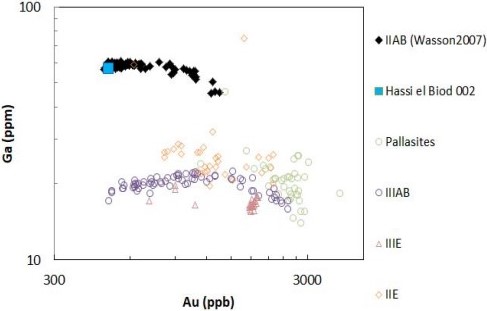
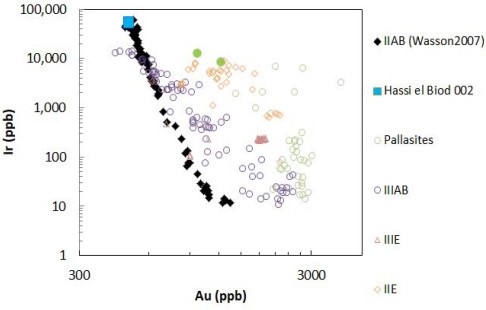
In a subsequent analysis of HeB 002 conducted by Boesenberg et al. (2023 #2376), ~1 vol% pyroxene was found to be present as both orthopyroxene and diopside. In addition, they observed that HeB 002 metal has a trace element composition that is nearly identical to that of the IIAB iron Negrillos, which is from an early crystallized core unit (see diagrams below). This data establishes a common genetic link between HeB 002 and IIAB irons, thus enabling advanced studies through silicate analyses including isotopic investigations.
Ga vs. Au and Ir vs. Au Concentrations for HeB 002 and Iron Groups
Diagrams credit: Boesenberg et al., 54th LPSC, #2376 (2023)
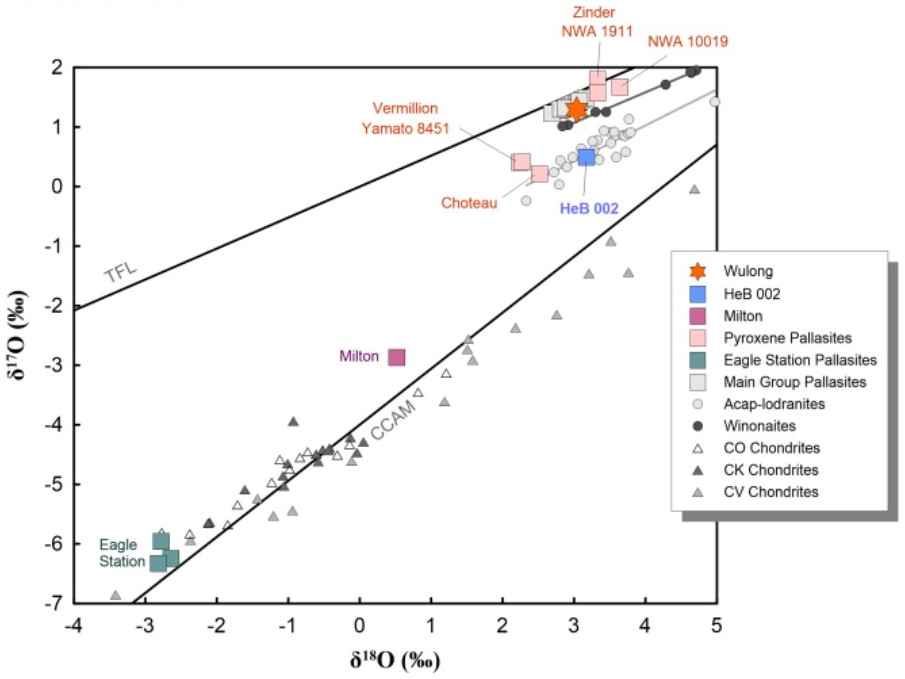
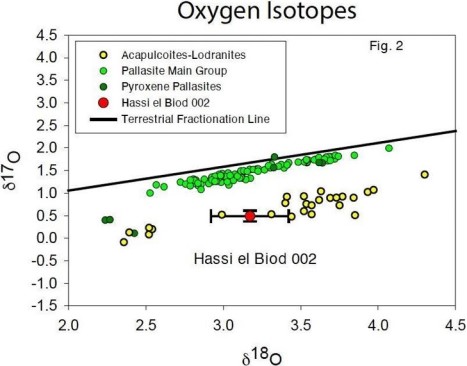
Hassi el Biod 002 and the three pyroxene pallasites Vermillion, Y-8451, and Choteau have similar O-isotopic compositions (see diagrams below). However, HeB 002 and Choteau have disparate olivine compositions (HeB 002: Fa7.6 [±0.1]; Choteau: Fa9.2–10.1/10.3 [±0.6]) and olivine FeO/MnO ratios (HeB 002: 24 [±1]; Choteau: 27–35/33.5 [±2.5]), which indicates they are not genetically related (MetBull and Gregory et al., 2016). Based on oxygen isotopes, Hassi el Biod 002, Vermillion, Y-8451, and Choteau all plot within the field of the large acapulcoite–lodranite clan (see plot 1 and 2). However, differences in mineral chemistry would seem to exclude any genetic relationship between HeB 002 and the acapulcoite–lodranite clan. Furthermore, it was demonstrated by Dey and Yin (2022 #2428) on a coupled Δ17O and ε54Cr diagram that Choteau is not related to Vermillion. Vermillion plots in a unique space between the winonaite and acapulcoite–lodranite fields, while Choteau plots in the extensive ureilite field (see the Vermillion and Choteau respective pages. Nevertheless, a potential relationship between HeB 002 and the diverse acapulcoite–lodranite clan is being assessed (Agee et al., 2022 #6428).
Oxygen Isotope Composition of Ungrouped Pallasites
click on image for a magnified view
Diagram credit: Liu et al., 54th LPSC, #1235 (2023)
Triple Oxygen Isotopes for Hassi el Biod 002
Diagram credit: Agee et al., 85th MetSoc, #6428 (2022)
Some proposed scenarios for pallasite formation can be found on the Imilac page. The specimen of Hassi el Biod 002 shown above is an 18.3 g partial slice, photography courtesy of Mark Lyon.
Hassi el Biod 002 Slice and Individual
Photos courtesy of Dr. Carl Agee—UNM