C7[–8/PAC]-ung ('CX')
(Achondrite ungrouped in MetBull 105)
Purchased May 2015
no coordinates recorded
A single 407 g meteorite was found in the Sahara Desert, possibly near Tan Tan, Morocco, and subsequently purchased by F. Kuntz in Zagora, Morocco on behalf of Planetary Studies Foundation in Galena, Illinois. An analysis was conducted at the University of Washington in Seattle (A. Irving and S. Kuehner), and NWA 10503 was determined to be a texturally-evolved meteorite exhibiting ~120° triple junctions with no relict chondrules visible. The elevated silicate FeO/MnO ratios are higher than those for ordinary chondrites and are consistent with a carbonaceous chondrite classification. In May 2016, a lot of smaller stones having a combined weight of 215 g was purchased by B. Hoefnagels. This group of stones was designated NWA 10859, and results of petrographic and isotopic analyses (A. Irving and S. Kuehner, UWS; K. Ziegler, UNM) led to the determination that they are paired with NWA 10503.
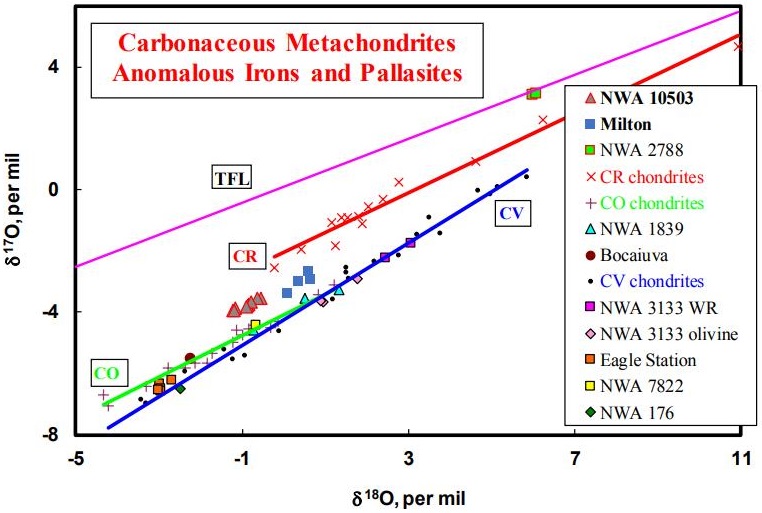
On an oxygen three-isotope diagram the values plot away from all other analyzed meteorites and along an extension of the trend line for the ungrouped pallasite Milton (K. Ziegler, UNM; see diagram below). NWA 10503 was initially classified as an ungrouped carbonaceous metachondrite that might be related to the Milton pallasite.
click on image for a magnified view
Diagram credit: Irving et al., 79th MetSoc, #6461 (2016)
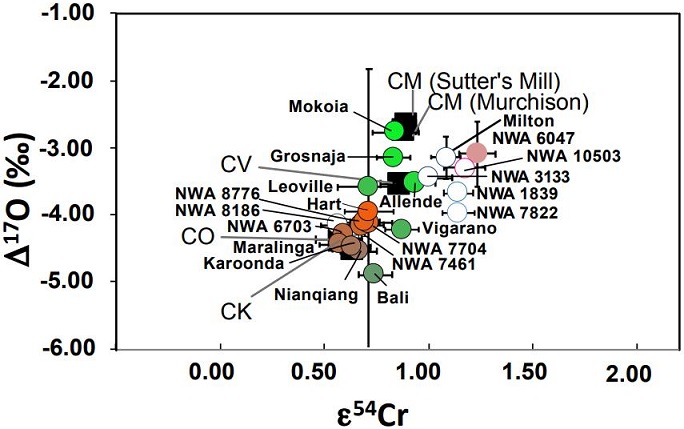
In an effort to better resolve potential genetic relationships that might exist among these meteorites, a Cr-isotopic analysis was conducted by Sanborn et al. (2018) for NWA 10503 as well as for olivine from the Milton pallasite. It is demonstrated on a coupled Δ17O vs. ε54Cr diagram (shown below) that both meteorites plot among the CV clan and plausibly share a genetic relationship.
Chromium vs. Oxygen Isotope Plot
click on image for a magnified view
Diagram credit: Sanborn et al., 49th LPSC, #1780 (2018)
In an effort to further resolve differences between the CV and CK chondrite groups, Yin and Sanborn (2019) analyzed Cr isotopes in a significant number and broad range of meteorites. Their study included samples from each of the three CV subgroups (oxA, oxB, Red), anomalous CV3 chondrites, a C3-ungrouped, several CK members, and other potential CV-related meteorites including NWA 10503 and Milton (see top diagram below). It is demonstrated that the CV and CK meteorites are clearly resolved into two distinct isotopic reservoirs. In addition, it is shown by the ε54Cr values that NWA 10503 plots among the CV-related meteorites. A coupled Δ17O vs. ε54Cr diagram plotting all of the meteorites in the study is shown in the bottom diagram below.
Cr Isotope Weighted Average For CV and CK Chondrites
click on image for a magnified view
O–Cr Diagram For CV and CK Chondrites
CK: orange shades; CV: green shades; Achondrites: open
click on image for a magnified view
Diagrams credit: Yin and Sanborn et al., 50th LPSC, #3023 (2019)
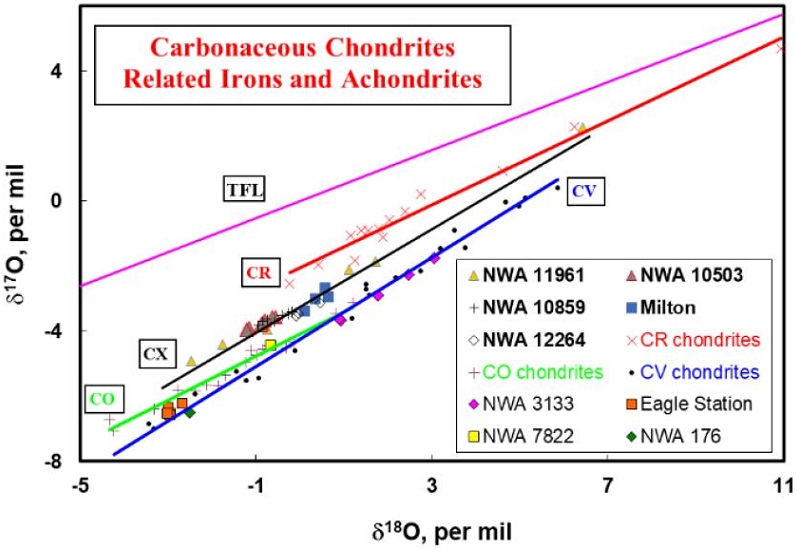
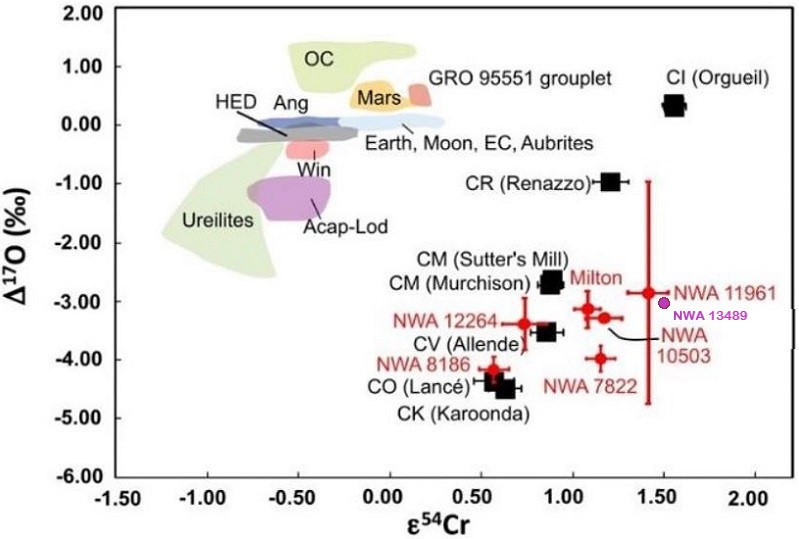
Importantly, Cuppone et al. (2024 #6029) noted that NWA 13489 plots on the same O-isotope trend line as several other ungrouped CC meteorites formerly recognized by Irving et al. (2019 #2542), who gave it the unofficial name 'CX trend' (see first diagram below). In addition to having a similar O-isotopic trend, NWA 13489 and NWA 11961 have identical (within error) ε54Cr values of +1.50, which indicates they likely have a genetic connection. At the same time, 54Cr isotope data obtained for several other meteorites have resolved both NWA 11961 and NWA 12264 as two potentially new carbonaceous parent bodies, and suggest that the parent body of NWA 13489 and NWA 11961 may be distinct from that of NWA 10503 and Milton, the latter two previously considered possible members of the CV-clan (see second diagram below). However, further in-depth analyses of NWA 13489 conducted by Cuppone et al. (2025) has led them to revisit whether a genetic relationship exists between all four meteorites—NWA 13489, NWA 11961, NWA 10503/10859, and Milton—and based on many factors, they now consider such a relationship to be plausible (see third diagram below).
1. 'CX' Oxygen Isotope Trend Line
click on image for a magnified view
2. O–Cr Diagram for 'CX' Trend Meteorites
NWA 11961 mean Δ17O = –2.87‰ (SD = 1.89)
NWA 13489 mean Δ17O = –3.010‰; NWA 13489 mean ε54Cr = +1.50 (Cuppone et al., 2024)
click on image for a magnified view
Diagrams credit: Irving et al., 50th LPSC, #2542 (2019)
'Evidence For A Unique Carbonaceous Chondrite Parent Body ('CX') And Another One With A Dunitic Mantle'
3. Oxygen and Chromium Isotopic Plots for NWA 13489
click on image for a magnified view
Diagram credit: Cuppone et al., MAPS, vol. 60, #8, pp. 1861–1876, fig. 8 (2025, open accesslink)
'Northwest Africa 13489: A Strongly Metamorphosed Ungrouped Carbonaceous Chondrite'
(https://doi.org/10.1111/maps.70007)
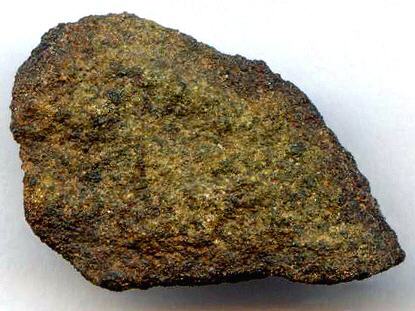
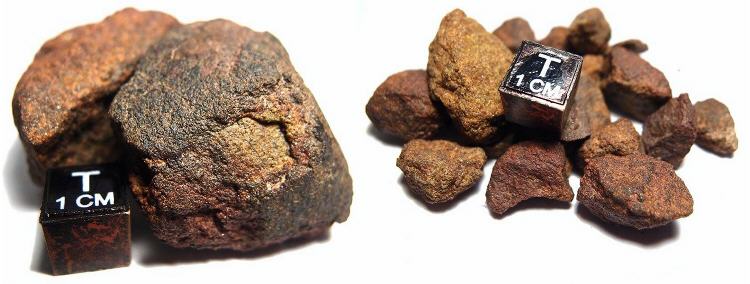
Northwest Africa 10503 is a somewhat friable meteorite with features indicating a low degree of terrestrial weathering and a low shock stage. Two views of a 3.79 g fragment of NWA 10503 are shown above. In the top photo below are some of the larger stones representing the paired NWA 10859, while two stones of NWA 10503 with green-colored fusion crust are shown in the bottom photo.