While sorting through a Moroccan dealer's unclassified meteorites at the Tucson Gem and Mineral Show, G. Hupé noticed one in particular consisting of two pieces totaling 324.3 g. After purchasing the two unique stones, samples were obtained for analysis and classification by the University of Washington in Seattle (A. Irving and S. Kuehner), Arizona State University (L. Garvie), and the University of New Mexico (K. Ziegler). Following a complete analysis, NWA 11961 was classified as an ungrouped type 3 carbonaceous chondrite.
The relatively fresh meteorite is composed of ~83 vol% distinct, unequilibrated chondrules (olivine Fa0.9–34.0) measuring 840 (±500) µm in diameter, some with partial metal rims. The fine-grained matrix constituting ~15 vol% contains kamacite and trolite along with anorthite. The type sample contained no CAIs, nor were any phyllosilicates, clay minerals, or magnetite identified. A low degree of terrestrial weathering is evident in minor calcite formation within the stone.
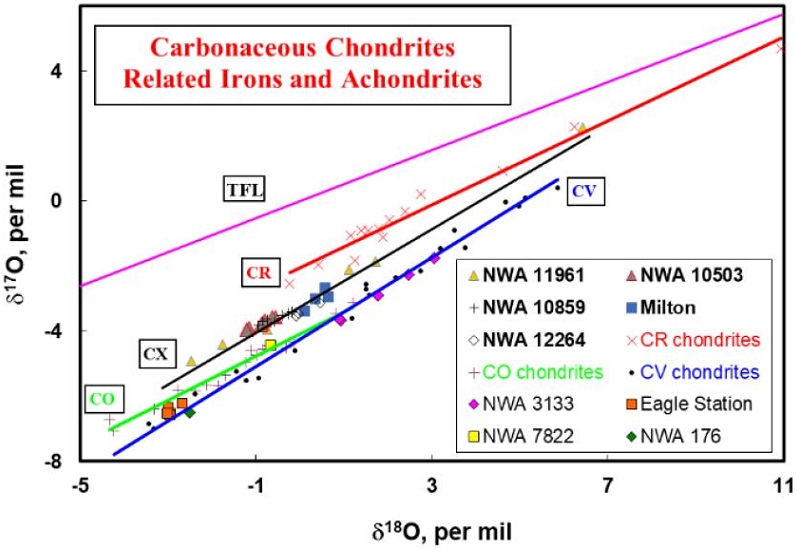
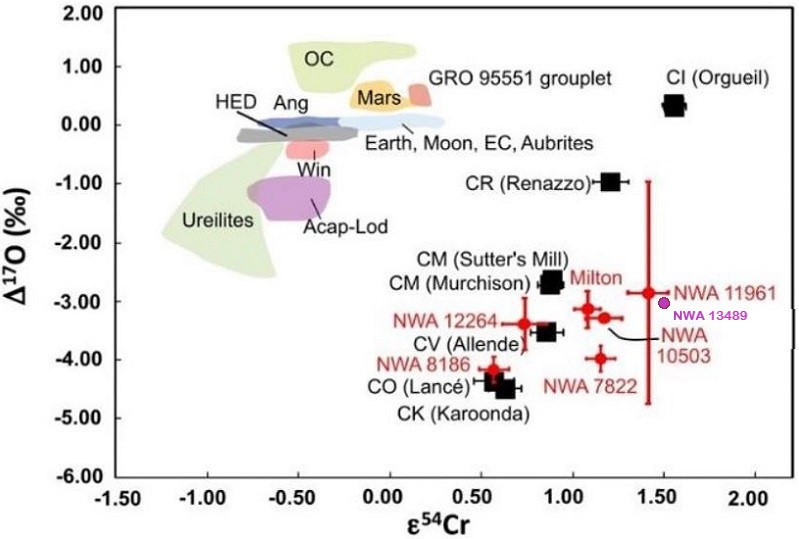
Importantly, Cuppone et al. (2024 #6029) noted that NWA 13489 plots on the same O-isotope trend line as several other ungrouped CC meteorites formerly recognized by Irving et al. (2019 #2542), who gave it the unofficial name 'CX trend' (see first diagram below). In addition to having a similar O-isotopic trend, NWA 13489 and NWA 11961 have identical (within error) ε54Cr values of +1.50, which indicates they likely have a genetic connection. At the same time, 54Cr isotope data obtained for several other meteorites have resolved both NWA 11961 and NWA 12264 as two potentially new carbonaceous parent bodies, and suggest that the parent body of NWA 13489 and NWA 11961 may be distinct from that of NWA 10503 and Milton, the latter two previously considered possible members of the CV-clan (see second diagram below). However, further in-depth analyses of NWA 13489 conducted by Cuppone et al. (2025) has led them to revisit whether a genetic relationship exists between all four meteorites—NWA 13489, NWA 11961, NWA 10503/10859, and Milton—and based on many factors, they now consider such a relationship to be plausible (see third diagram below).
1. 'CX' Oxygen Isotope Trend Line
click on image for a magnified view
2. O–Cr Diagram for 'CX' Trend Meteorites
NWA 11961 mean Δ17O = –2.87‰ (SD = 1.89)
NWA 13489 mean Δ17O = –3.010‰; NWA 13489 mean ε54Cr = +1.50 (Cuppone et al., 2024)
click on image for a magnified view
Diagrams credit: Irving et al., 50th LPSC, #2542 (2019)
'Evidence For A Unique Carbonaceous Chondrite Parent Body ('CX') And Another One With A Dunitic Mantle'
3. Oxygen and Chromium Isotopic Plots for NWA 13489
click on image for a magnified view
Diagram credit: Cuppone et al., MAPS, vol. 60, #8, pp. 1861–1876, fig. 8 (2025, open accesslink)
'Northwest Africa 13489: A Strongly Metamorphosed Ungrouped Carbonaceous Chondrite'
(https://doi.org/10.1111/maps.70007)
Multiple analytical techniques were applied by Irving et al. (2022 #2046) and Garvie and Irving (2022 #2217; XRD data) to a number of previously classified carbonaceous chondrites. High-precision oxygen isotope data obtained by Irving et al. (2022) for a broad sampling of meteorites enabled them to define two new CC region trend lines that are nearly aligned with those previously known (see diagram below). The data points delineate a new carbonaceous group of at least 16 meteorites that was termed 'CT chondrites', a toponym for the type 3 group member Telakoast 001. This group currently comprises petrologic type 2 and type 3 members. With further analyses, including nucleosynthetic anomalous 54Cr values, it may be determined that other variously classified stones (e.g., NWA 13167 [C2-ung], NWA 13249 [C2-ung], NWA 13456 [C2], NWA 13455 [CO3-an], and NWA 13479 [C2-ung]) with petrographic, chemical, mineralogical, magnetic susceptibility, and isotopic similarities to those in the initial study also belong in the CT group. The other proposed carbonaceous group was termed 'CZ chondrites', the members of which have O isotopes that plot below the CM trend and have higher δ17O values and lower magnetic susceptibilities than members of the CT group.
Oxygen Isotope Plot for Carbonaceous Chondrite Groups
(note that Qued Mya 002 has a nearly identical plot as NWA 11699)
click on image for a magnified view
Diagram credit: Irving et al., 53rd LPSC, #2046 (2022)
'CT Chondrites: A Newly Recognized Carbonaceous Chondrite Group With Multiple Members, Including Telakoast 001, Chwichiya 002 And Cimarron'
The photo of NWA 11961 shown above, perfectly photographed by Greg Hupé, is a 10.4 g complete slice. It exhibits the typical features of this unique chondrite including a number of dark inclusions not yet described.