Tissemouminite, type 5/6
Chondritic Primitive Achondrite
Previously Winonaite (MetBull 87) or 'W Chondrite'
Purchased November 27, 2000
no coordinates recorded
Three fragments with a combined weight of 1,001 g were found and subsequently sold in Erfoud, Morocco to Canadian collector D. Gregory. This meteorite was analyzed and classified through a collaboration with UCLA and Washington University in St. Louis and was determined to be a primitive winonaite. A 23 g specimen of NWA 1463 is curated by UCLA, while the 975 g type specimen is on deposit with the Royal Ontario Museum.
Although the mineral composition of NWA 1463 is typical for the primitive achondrite group of winonaites, it has a more primitive, more chondritic texture than most other members of the group, equivalent to a petrologic type 5 chondrite (Benedix et al., 2003). In contrast to most other winonaites, NWA 1463 does not exhibit features related to igneous fractionation processes; such features had supported the original designation of winonaites as primitive achondrites. NWA 1463 contains abundant relict chondrules, which are found infrequently in only a few anomalous winonaite members (e.g., Pontlyfni, Mount Morris) embedded within a recrystallized groundmass. By contrast, most other winonaites have features consistent with extensive thermal metamorphism, e.g., a texture consisting of uniform-sized grains forming 120° triple junctions.
Textural comparison of four winonaites, L to R: NWA 1463 (with relict chondrule), Winona, Tierra Blanca, HaH 193
Image credit: Floss et al., MAPS, vol. 43, #4, p. 660 (2008)
'Evolution of the winonaite parent body: Clues from silicate mineral trace element distributions'
(http://dx.doi.org/10.1111/j.1945-5100.2008.tb00676.x)
The O-isotope composition of NWA 1463 plots on an extension of the winonaite trend line. However, the high abundance of FeNi-metal and troilite as well as the absence of metallic and sulfide veining attests to a lower equilibration temperature than that of other winonaites.
Diagram credit: Bunch et al., 41st LPSC, #1281 (2010)
Based on similar silicate textures, reduced mineral chemistry, and O-isotopes, it has been presumed that the winonaites and the IAB complex irons originated on a common parent body. Because of its highly primitive nature, NWA 1463 might closely resemble the chondritic precursor material of the typical winonaites and silicate inclusions in IAB complex irons. In a similar way, it was determined by Hidaka et al. (2015) that FeNi-metal in the winonaite Y-8005 retains a near chondritic composition likely representative of the precursor material of the parent body. Utilizing a Ge/Ni vs. Au/Ni coupled diagram, they found that metal in Y-8005 plots in the field of the sLL subgroup of the IAB complex irons. In view of these findings, Hidaka et al. (2015) suggested that the sLL subgroup rather than the main group of the IAB complex represents the primitive metal of the IAB–winonaite parent body, with the main group possibly representing a partial melt of the sLL subgroup. Analysis of metal in the winonaite Y-8005 was shown by Hidaka et al. (2019) to be consistent with that of IAB sLL subgroup irons, which supports such a genetic relationship. In their analysis of the IAB iron complex, Worsham et al. (2017) demonstrated that the Mo isotope data for the two winonaites they studied, Winona and HaH 193, also attest to a common parent body for winonaites and the MG/sLL irons.
Northwest Africa 1463 does not fit into the scheme that has been commonly used to define the primitive achondrite group, and it could be instrumental in the future in redefining the metamorphic progression of chondrites to primitive achondrites. To that end, Irving et al. (2005) described this meteorite as possibly representing the regolith of the winonaite parent body. Furthermore, they argued that the occurrence of distinct chondrules precludes the use of the term achondrite to describe this meteorite, and suggest that the term metachondrite or 'W chondrite' would be more appropriate to describe this texturally-evolved meteorite pairing group (Irving et al., 2005; Irving and Rumble III, 2006 #5288).
Northwest Africa 1463 has certain features that are unique compared to most other winonaites, and while it is plausible that this meteorite may represent the winonaite precursor material, it has been conjectured that it may instead have originated on a separate parent body (Floss et al., 2008). These unusual features include the lowest degree of metamorphism of all winonaites, an anomalous chromite composition, an anomalous O-isotopic composition, a lack of graphite, the presence of merrillite rather than apatite, and an abundance of incompatible trace elements intermediate to other winonaites. The variability in Ar–Ar ages obtained for some winonaites indicates they may have been excavated from different depths over an extended period of time (Scott et al., 2014). Furthermore, cooling rates standardized at ~500°C were determined for a number of winonaites and IAB irons, and the results demonstrate that a wide continuum exists:
Pontlyfni—1,000–10,000°C/m.y.
Winona—200°C/m.y.
NWA 1463—100°C/m.y.
Fortuna and QUE 94535—30°C/m.y.
IAB irons—10–25°C/m.y.
Based on the oxygen isotope data obtained by Hunt et al. (2012) for silicate inclusions in IAB irons, along with the observed volatile element depletions, it could be inferred that the winonaite precursor likely had a volatile-depleted carbonaceous chondrite-like composition. From results of their trace element analyses of a broad sampling of winonaites, Hunt et al. (2017) recognized that CM chondrites represent the closest match; however, the important differences that do exist indicate that the precursor to winonaites is unlike any meteorite class currently known. In another study employing Mo and W isotope data (e.g., Kruijer et al., 2017) demonstrate that the IAB complex irons, and thus the genetically-related winonaites, accreted in the non-carbonaceous reservoir (see the Protoplanetary Disk page for further details). Preliminary data based on Al–Mg chronometry show that the similar NWA 725 was formed ~1.4 m.y. after CAIs. This age is consistent with Hf–W ages in the range of 1.5–5 m.y. that were calculated for more highly metamorphosed winonaites (Hidaka et al., 2014).
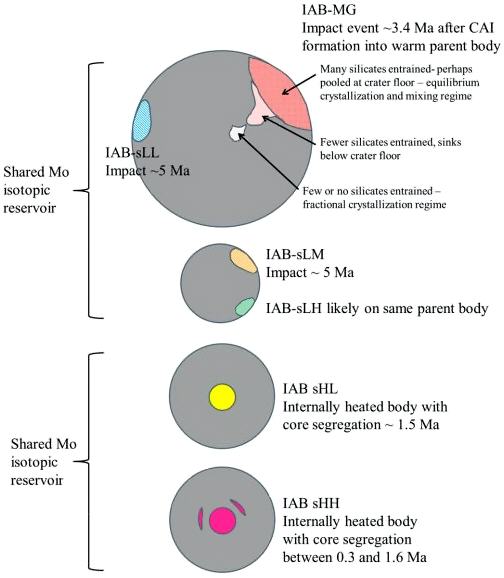
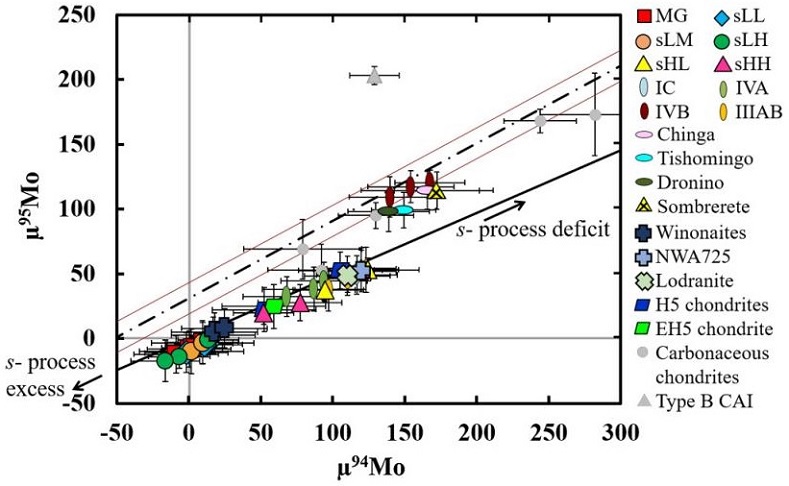
New analyses were conducted by Worsham et al. (2017) for IAB complex irons, along with two winonaites (Winona and HaH 193), a lodranite (GRA 95209), the primitive achondrite NWA 725, and other selected meteorite groups. Employing precise Mo, W, and Os isotope data along with HSE and other literature data, they ascertained that the IAB complex irons represent at least three distinct parent bodies and at least three impact-generated metal–silicate segregation events (see top schematic diagram below). Moreover, they determined that the Mo isotope data as well as the chemical and mineralogical data attest to a common parent body for the winonaites and the MG/sLL irons. Importantly, they demonstrated that the Mo isotope values for NWA 725 do not plot with the IAB MG/sLL/winonaites, and that the values are all higher than those of the lodranite in their study. Notably, the Mo isotope values of NWA 725 plot within the field of the magmatic sHL and sHH irons, which are not genetically related to the other IAB parent bodies (see bottom diagram below). Oxygen isotope data for the sHL and sHH irons could help resolve whether any potential genetic relationship exists with NWA 725 and similar meteorites like NWA 1463.
CRE-corrected Mo Isotopic Compositions of Meteorite Groups
(µ notation denotes deviation from terrestrial standards in parts per million)
click on diagram for a magnified view
Diagrams credit: Worsham et al., Earth and Planetary Science Letters, vol. 467, pp. 157–166 (2017)
'Characterizing cosmochemical materials with genetic affinities to the Earth: Genetic and chronological diversity within the IAB iron meteorite complex'
(https://doi.org/10.1016/j.epsl.2017.02.044)
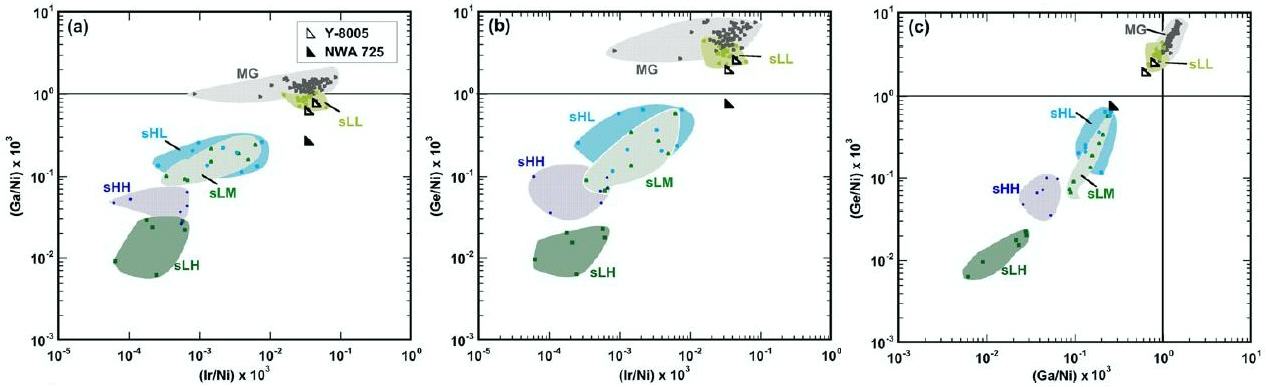
In their chemical composition analysis of metal in primitive achondrites, which included the two winonaites NWA 725 and Y-8005, Hidaka et al. (2019) demonstrated that these two meteorites have significant differences in abundances of the moderately volatile siderophile elements Cu, Sb, Ga, Ge, and Sn. Moreover, utilizing coupled diagrams for various elemental abundance ratios in metal, they demonstrated that NWA 725 does not plot together with Y-8005 in the sLL subgroup field, but rather it generally plots in a unique space between the sLL and the overlapping sHL and sLM fields; notably, in the Ga/Ge coupled diagram NWA 725 plots at the very border of the sHL and sLM fields (see diagrams below). It was concluded that the metal in NWA 725 and Y-8005 had separate origins, and that NWA 725 possibly represents a reassembled daughter body that was contaminated by metal from the projectile which disrupted the IAB parent body.
Chemical Composition of Winonaite Metals and IAB Iron Subgroups
click on diagram for a magnified view
Diagrams credit: Hidaka et al., MAPS, vol. 54, #5, p. 1158 (2019)
'Siderophile element characteristics of acapulcoite–lodranites and winonaites: Implications for the early differentiation processes of their parent bodies'
(https://doi.org/10.1111/maps.13273)
It was previously considered that NWA 1463 is likely paired with NWA 725, NWA 1052, NWA 1054, and NWA 1058 (Irving and Rumble III, 2006); a further possible pairing was found in 2007 and designated NWA 4835 (T. Bunch, NAU). However, new analyses by Stephant et al. (2023) indicate that only NWA 1052 and NWA 1054 are fall paired, and that based on variability in their modal abundances (see Fig. 3) the other samples represent distinct ejection events from a common parent body.
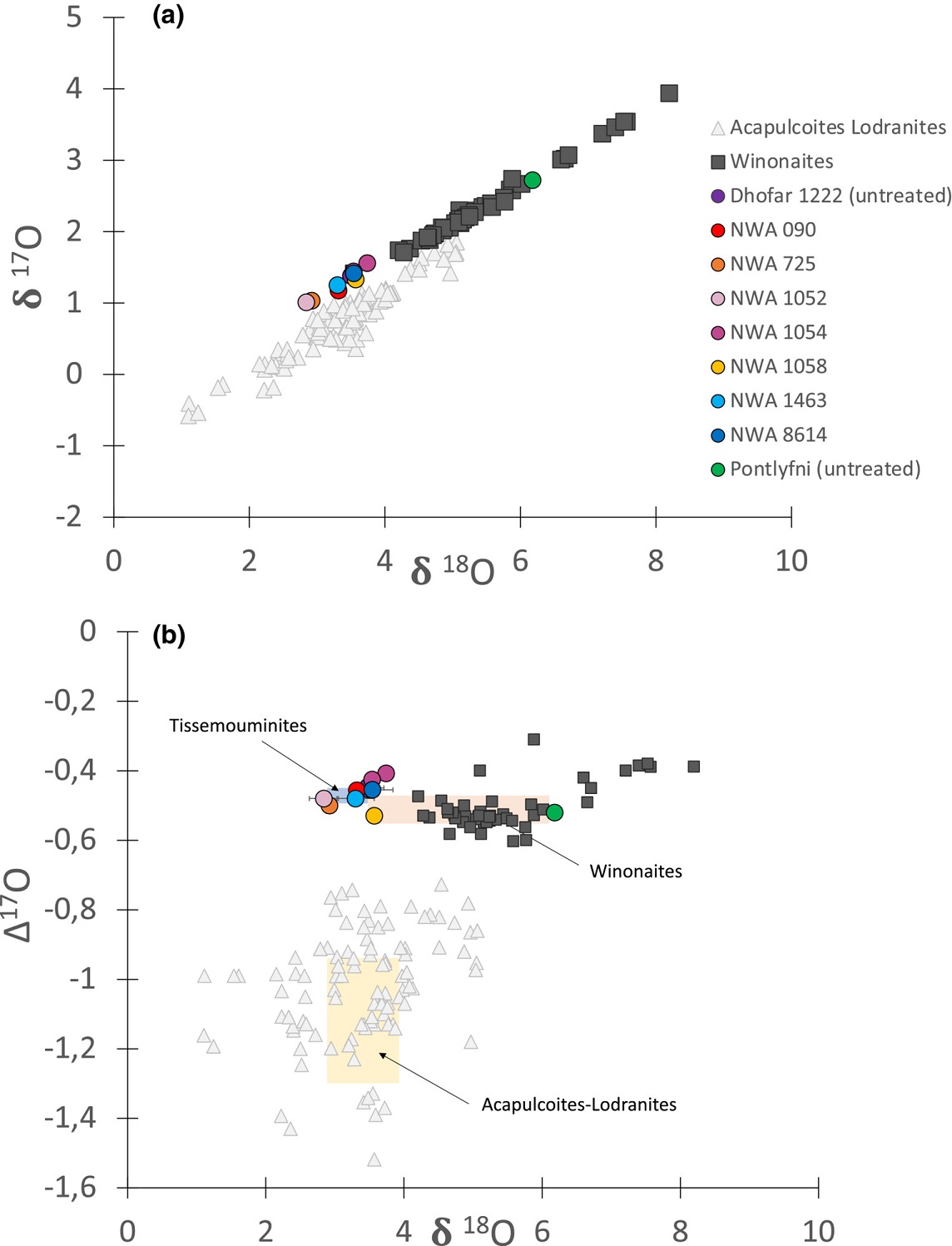
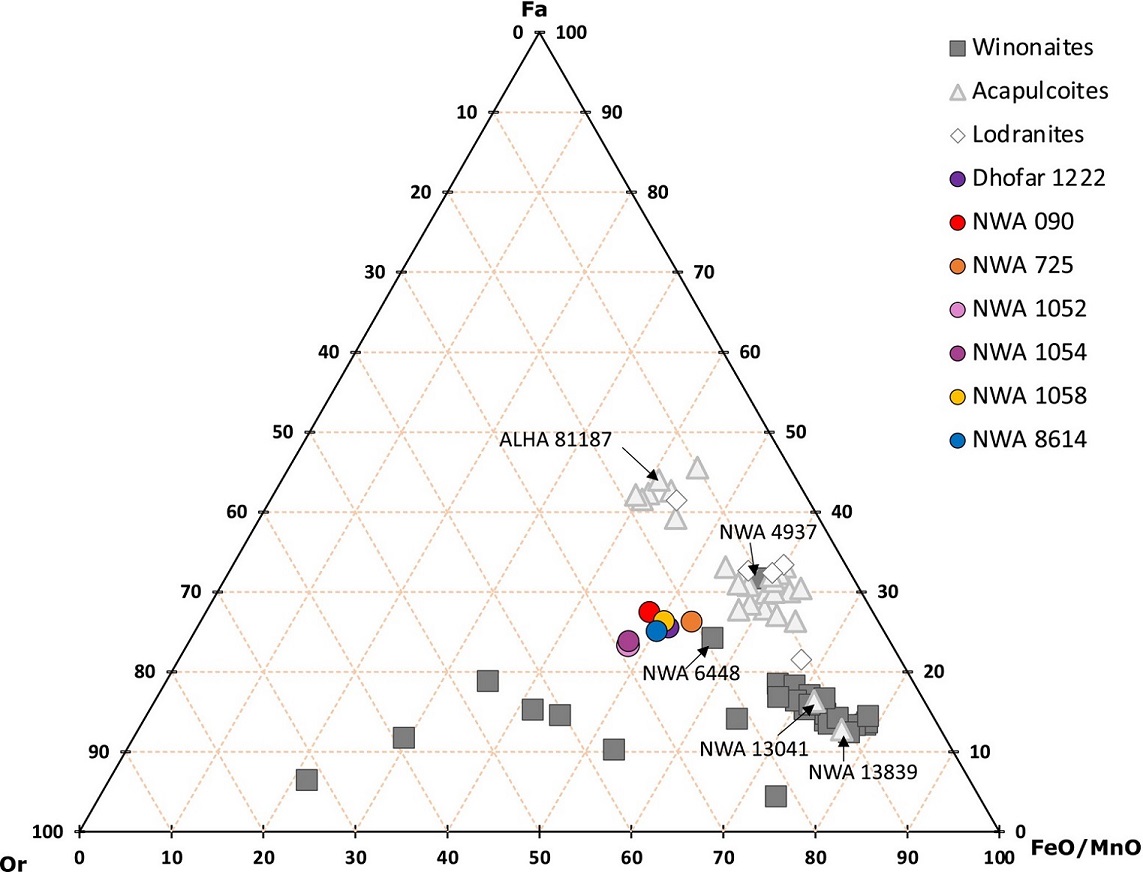
Stephant et al. (2023) investigated NWA 1463 and seven very similar meteorites (Dhofar 1222, NWA 090, NWA 725, NWA 1052, NWA 1054, NWA 1058, and NWA 8614) using newly acquired data for NWA 090 and literature data for each of the other meteorites. The authors went to great depths with regard to the petrography, mineralogy, isotopy, geothermometry, and especially the geochemistry of these samples in an effort to resolve the subtle differences that exist between them and the winonaite and acapulcoite groups. They were able to show through various means, but especially utilizing an oxygen three-isotope diagram and a ternary diagram combining olivine fayalite content, olivine FeO/MnO ratio, and plagioclase Or content, that the tissemouminite group is resolved from the winonaite and acapulcoite groups (see diagrams below).
Oxygen Isotope Diagrams Resolve the Tissemouminite Group
click on diagram for a magnified view
A Ternary Diagram Resolves the Tissemouminite Group
click on diagram for a magnified view
Diagrams credit: Stephant et al., MAPS, vol. 58, #1, figs. 10, 11 (2023 open accesslink)
'Tissemouminites: A new group of primitive achondrites spanning the transition between acapulcoites and winonaites'
(https://doi.org/10.1111/maps.13944)
Other potential members of the new tissemouminite group (e.g., NWA 4816 [ACA], NWA 4937 [WIN], NWA 6448 [WIN], SuV 014 [ACA], Y-983237 [ACA]) share some of the same characteristics as the eight known members, but each will need further work to distinguish to which of the three groups it belongs.
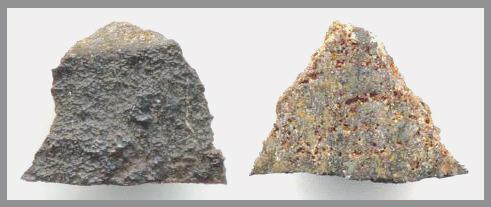
Further details about this recently resolved group can be found on the NWA 725 page. Shown above are two views of a 0.12 g cut fragment of NWA 1463 which show its chondritic texture and relatively fresh fusion crust. This specimen was kindly provided by Dr. David Gregory.