C3-ung
(potential CM-anomalous; van Kooten et al., 2026)
click on image for a magnified view
Purchased January 2023
no coordinates recorded
A stone weighing ~15 g along with numerous smaller pieces (pers. comm.) were found at an undisclosed location, and this material was subsequently purchased by F. Kuntz in Rissani, Morocco. A sample was sent to CEREGE (European Centre for Research and Teaching in Environmental Geosciences) for analysis and classification (J. Gattacceca, D. Borschnek, C. Sonzogni, and D. Au Yang), and NWA 16000 was classified as an ungrouped type 3 carbonaceous chondrite.
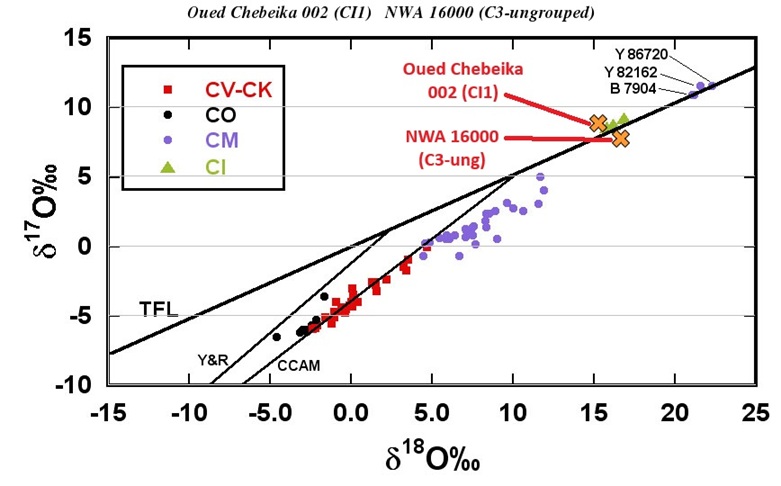
The relatively fresh meteorite is composed of distinct, unequilibrated chondrules (olivine Fa0.9–62.9 mol%) measuring 390 (±240) µm, embedded together with CAIs (up to 100 µm) in a fine-grained matrix constituting ~81 vol%. Other phases present include sulfides, rare metal, and framboidal-like magnetite clusters (see image), the latter perhaps similar to framboidal pseudo-magnetite (wüstite) identified in a Ryugu sample by Kimura et al. (2022); notably, no phyllosilicates or other hydrous phases were identified in the NWA 16000 analysis. An oxygen isotope analysis shows that NWA 16000 plots with Ryugu samples and CI chondrites (see diagram below).
O-isotope Plot for CI1 Oued Chebeika and C3-ung NWA 16000
click on diagram for a magnified view
Diagram adapted from the Meteoritical Bulletin Oxygen Isotope Plots—The Meteoritical Society
Northwest Africa 16000 was among a number of anomalous carbonaceous chondrites utilized by van Kooten et al. (2026) in support of a proposed novel protoplanetary disk model. They obtained new and/or literature isotopic data for NWA 16000, including Δ17O (–1.00), µ54Fe (21.6 [±2.5]), µ30Si (30.6 [±2.8]), µ26Mg* (1.9 [±2.5]), and µ54Cr (119.9 [±6.5]). They suggest a potential classification for NWA 16000 as CM-an, which plots on an extension of the CM trend line but with heavier oxygen isotopic values (see their Fig. S1B). It was suggested by van Kooten et al. (2026) that the dominant carrier of 54Cr in the early Solar System was likely water ice. In their scenario, 54Cr-rich material with an initial µ54Cr of 222 ppm experienced loss of 54Cr through thermal processing (e.g., chondrule formation, ice sublimation and recondensation), which caused a depletion down to the average CI µ54Cr abundance of 156 ppm. Thereafter, secondary aqueous alteration processes on the parent body further depleted the µ54Cr abundance. The relatively high µ54Cr abundance of NWA 16000 at 119.9 ppm is consistent with a low degree of thermal metamorphism as indicated by its type 3 classification (see their Fig. 4). The µ54Cr value is also consistent with its high matrix component of ~80 vol%, for which a correlation has been demonstrated to exist (see their Fig. 3). The matrix in these anomalous meteorites arguably has a cometary or outer-disk dark clast (ODD)-like origin.
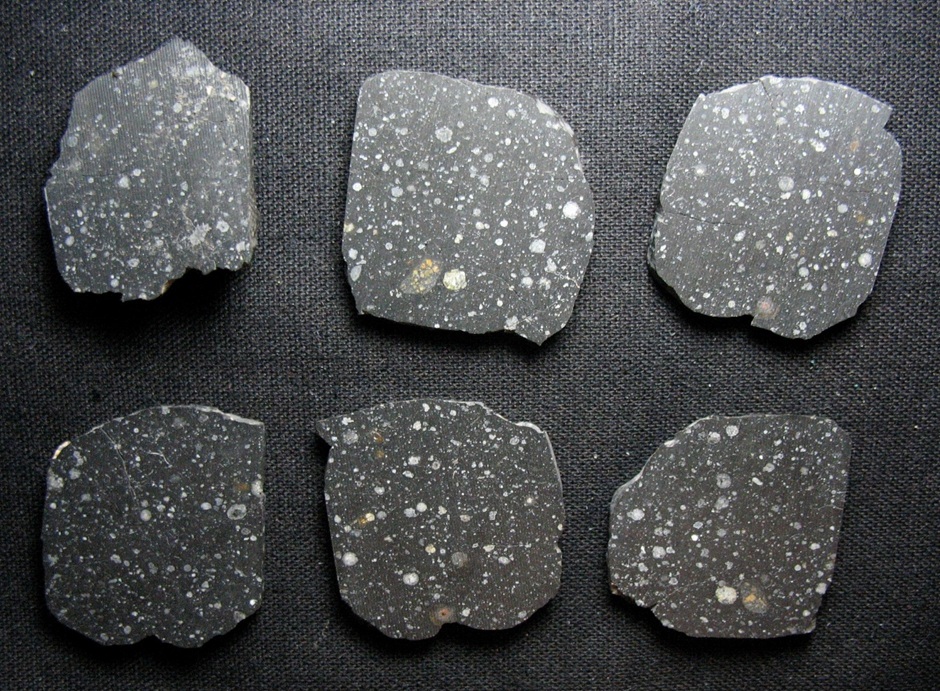
The photo of NWA 16000 shown above is a 3.05 g slice, shown courtesy of F. Kuntz. The meteorite exhibits the typical features of this unique carbonaceous chondrite as demonstrated in the photo of multiple slices below.
click on diagram for a magnified view
Photo courtesy of Fabien Kuntz—WWMeteorites