EL Impact-Melt Rock
Mc Ardle et al. (2025)
(revised in 2008 from EH6 in MB 86 to E6 "pending further work")
Found April 2001
no coordinates recorded
A single highly weathered stone weighing 2,250 g was found by villagers near Remlia, Morocco, in April 2001. Northwest Africa 974 is composed primarily of enstatite and kamacite, along with minor plagioclase, oldhamite, daubreelite, alabandite, schreibersite, troilite, graphite and silica. It is moderately shocked to stage S4.
Despite its high content of kamacite, long considered to be diagnostic of an EH classification, other compositional characteristics are more consistent with an EL classification. Indeed, it was demonstrated by Macke et al. (2009) that these two groups do not actually differ in their iron content, and that they are indistinguishable in density, porosity, and magnetic susceptibility as well; however, differences in siderophile, chalcophile, and other mineralogical abundances can be employed to distinguish the two groups. For example, the presence of alabandite rather than niningerite in NWA 974 is typically diagnostic of the EL group, as is the relatively high content of anorthite present. The classifying investigator (A. Jambon, Université Pierre & Marie Curie) believes that these features represent anomalous characteristics attributable to the high metamorphism that the stone has experienced, and he has suggested a classification of EH6 as most appropriate for this stone.
On May 8, 2008 the classification of NWA 974 was revised by the Nomenclature Committee of the Meteoritical Society to reflect a recommendation of E6 chondrite, pending further analyses. Further studies were conducted to help resolve the ambiguity in the classification, and NWA 974 was designated by Hopp et al. (2021 #2002) as an EL6 chondrite.
A comprehensive study conducted by Mc Ardle et al. (2025) utilized geochemical and mineralogical data for a broad petrologic sampling of enstatite chondrites representing the two established chemical groups, EL and EH. They first determined which of the meteorites had experienced shock melting followed by either quenching or slow cooling, as well as possible annealing. These impact-melt rocks were eliminated from their study, while the remainder, which experienced only parent body thermal heating, were reevaluated for petrologic type. Since NWA 974 contains daubreelite and alabandite, and keilite was not found, the meteorite is consistent with a slowly cooled and possibly slightly annealed (S4) impact-melt rock, and therefore was not included in their subsequent petrologic type evaluation.
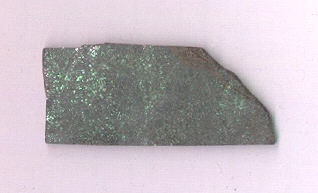
Further details about the new quantitative EC classification scheme of Mc Ardle et al. (2025) can be found in section II of the Systematics Part 5 page. The specimen of NWA 974 shown above is a 2.89 g partial slice.