F4 (forsterite chondrite)
(highly reduced)
(chondrite, ungrouped in MetBull 113)
Found April 2023
53° 31' 5" N., 68° 11' 3" E.
A relatively fresh (W1) regmaglypted stone weighing 163 kg was found by Asan Abykeev while using a metal detector to search for scrap metal. The large stone, which was partially buried in a plowed field near Saumalkol town in Kokchetav, Republic of Kazakhstan, showed indications of being a meteorite. A sample was submitted for analysis and classification to the Vernadsky Institute of Geochemistry and Analytical Chemistry, Russia (C.A. Lorenz), with additional analyses conducted at the Institute of Geology of Ore Deposits, Petrography, Mineralogy and Geochemistry of the Russian Academy of Sciences, Russia (S.E. Borisovsky), and the European Centre for Research and Teaching in Environmental Geosciences, France (J. Gattacceca et al. [oxygen isotopes, magnetic susceptibility]). Saumalkol was classified as an ungrouped chondrite, but is now considered to be a member of the F chondrite group which currently comprises 14 meteorites and several potential pairings (Kirby et al., 2025, 2026).
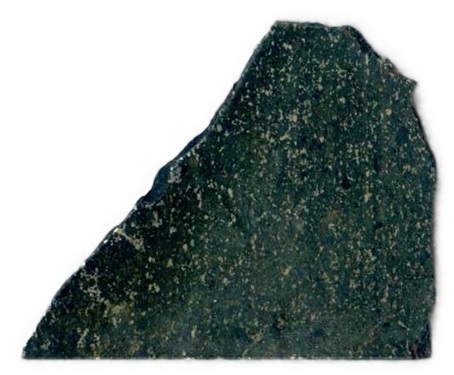
Saumalko is a highly reduced (olivine Fa4.36 [±0.17]) brecciated rock composed of chondrite fragments 5–10 cm in size (38 vol%) set within a host lithology (62 vol%) and separated by metal veins up to 2 cm wide. Fine-grained matrix is rare. A relatively high abundance of FeNi-metal and troilite are present in both the breccia fragments and the host lithology, with the bulk meteorite exhibiting a magnetic susceptibility mean value of 5.41. Accessory phases include chromite, rutile, chlorapatite, schreibersite, and native copper, along with minor terrestrial weathering products.
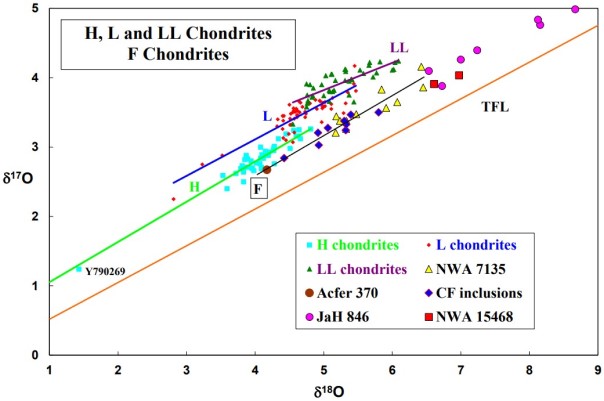
The oxygen isotope composition of Saumalkol plots very close to that of Acfer 370. These O-isotopic values infer a possible genetic grouping which defines a slope distinct from the ordinary chondrites. As demonstrated in the diagrams below, these meteorites plot far away from the trend lines for the H, L, and LL ordinary chondrite groups and probably represent a previously unrecognized parent asteroid.
Diagram credit: Irving et al., 54th LPSC, #2309 (2023)
'Evidence For A Previously Unrecognized Non-Carbonaceous Chondritic Parent Body From Petrologic And Oxygen Isotope Studies Of Ungrouped MG-Rich Chondrite Northwest Africa 15468'
Diagram credit: Pourkhorsandi et al., GCA, vol. 218, p. 109 (2017)
'The ungrouped chondrite El Médano 301 and its comparison with other reduced
ordinary chondrites'
(https://doi.org/10.1016/j.gca.2017.09.013)
See the NWA 7135 and NWA 5492 pages for further details about the F chondrite group. The specimen of Saumalkol shown above is a 3.1 g partial slice acquired from R. Vargas.