Diogenite
(4) Vesta/Vestoid origin
Noritic anorthosite
Purchased August 2022
29° 4' 37" N., 10° 44' 35" E.
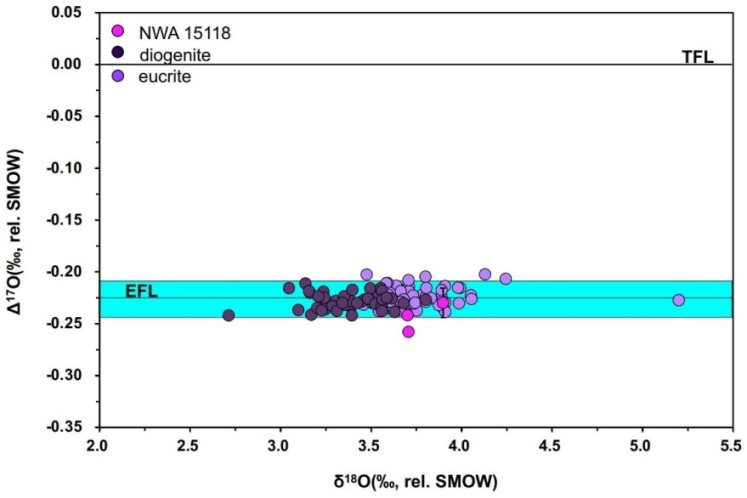
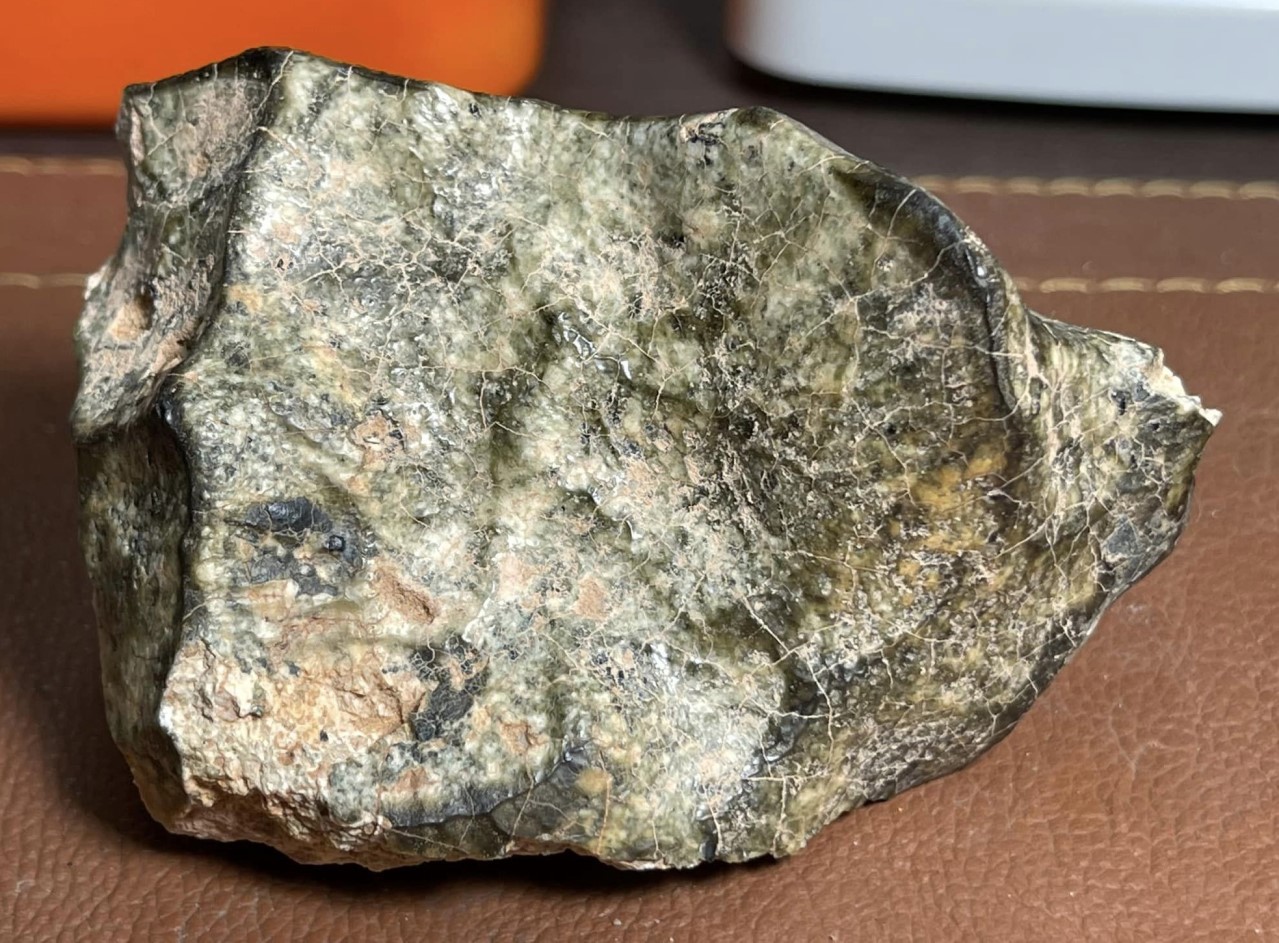
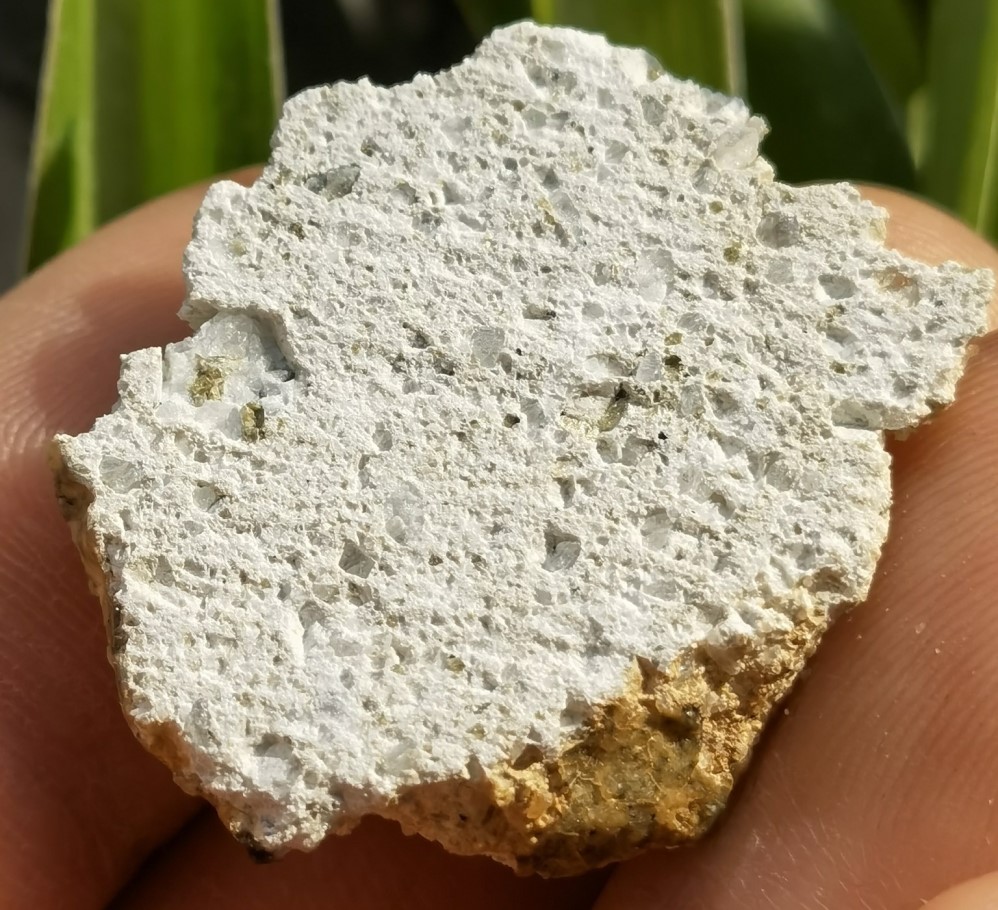
A single stone weighing 440 g was found near Ghadamis, Libya and subsequently purchased by A. Habibi from a Moroccan dealer. A sample was submitted for analysis and classification to the University of Washington in Seattle (A. Irving) and Washington University in St. Louis (P. Carpenter). Additional analyses were conducted at Bayerisches Geoinstitut, University of Bayreuth, and at the University of California, Los Angeles by Timoner et al. (2024). Based on the mineralogy and the oxygen isotopes of Wan Zawatin 001, which is composed of ~76-85 vol% anorthite and ~24-15 vol% orthopyroxene, respectively, along with accessory phases, it is classified as an ungrouped, anorthite-rich achondrite (norite to leuconorite) with affinities to diogenites. A paired 230 g mass, reportedly found in Algeria and designated NWA 15118, was purchased by D. Xu and classified at the Institute of Geochemistry Chinese Academy of Sciences in Guiyang, China (S. Li). The stone was determined to be a fragmental breccia composed of ~94 vol% anorthite and ~6 vol% orthopyroxene plus accessory phases; this find establishes the first anorthositic diogenite meteorite (see a systematic classification of diogenites) based on IUGS taxonomy.
Triple Oxygen Isotope Composition for NWA 15118
click on photo for a magnified view
Diagram credit: Li et al., Nature Astronomy, vol. 8, Fig. S4 (2024)
'An anorthositic meteorite supporting an ancient magma ocean on Vesta'
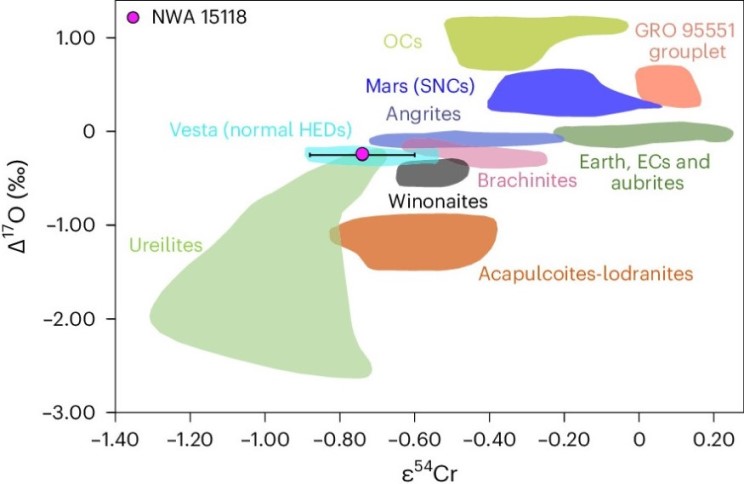
Oxygen and Chromium Isotope Composition for NWA 15118
click on photo for a magnified view
Diagram credit: Li et al., Nature Astronomy, vol. 8, Fig. 2 (2024)
'An anorthositic meteorite supporting an ancient magma ocean on Vesta'
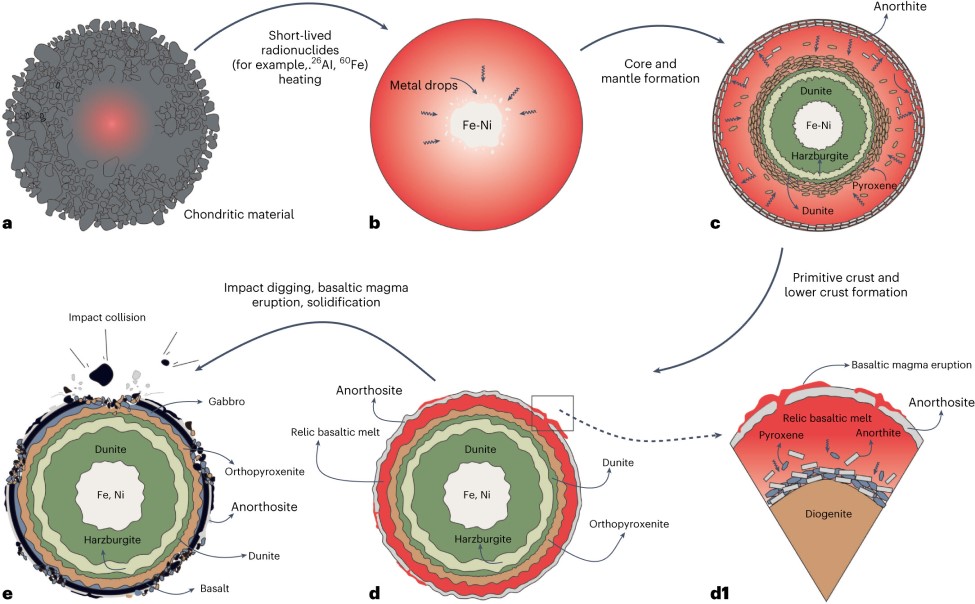
In 'An anorthositic meteorite supporting an ancient magma ocean on Vesta', published in Nature Astronomy by S. Li et al. (2024), the authors suggest that the anorthite-rich NWA 15118 and its pairing Wan Zawatin 001 represent a relatively thin (3.8 km) primary anorthositic flotation crust situated above a magma ocean or molten region on Vesta (see schematic diagram below). An alternative scenario suggested by Timoner et al. (2024) posits that these meteorites are associated with diogenite fractional crystallization at depth, i.e., anorthite-rich cumulates within a layered intrusion such as a sill or dike. A subsequent in-depth elemental analyses was conducted on NWA 15118 by Sheen et al. (2025). Through geochemical modeling, they concluded that this meteorite was not formed in a single-stage magmatic process like that of a flotation crust above a magma ocean. Instead, the anorthosite rock has likely experienced a more complex petrogenesis involving remelting and mixing procceses, as well as possible source heterogeneity, and is more consistent with a cumulate zone within a layered igneous intrusion. Importantly, Sheen et al. (2025) contend that the precursor lithology was a plagioclase cumulate not associated with fractionation of diogenite parental melts.
Scenario for the Formation of Wan Zawatin 001 on (4) Vesta
click on diagram for a magnified view
Diagram credit: Li et al., Nature Astronomy, vol. 8, Fig. S4 (2024)
'An anorthositic meteorite supporting an ancient magma ocean on Vesta'
A comprehensive analysis of the Al–Mg chronology for NWA 15118 conducted by Ren et al. (2025) provided a model crystallization age which is dated no earlier than 4.35 (± 0.03) m.y. after CAIs. This crystallization age is thought to postdate that of some diogenites, and is confirmed to postdate some eucrite ages by at least ~1.5 m.y. (see their Fig. 2). This relatively young age demonstrates that NWA 15118 (and by association Wan Zawatin 001) does not represent a primary anorthositic flotation crust on asteroid (4) Vesta, but instead, the authors suggest the meteorite was formed during a later melting event unrelated to the primary differentiation of Vesta, and/or that it derives from a chemically unique source region.
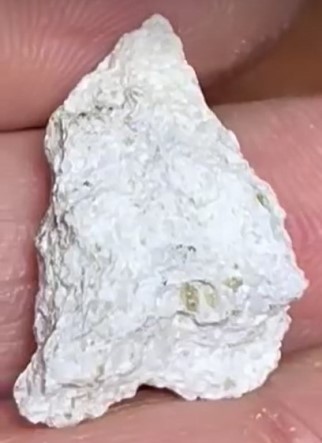
Due to the unique anorthositic mineralogy of Wan Zawatin 001, its pyroxene spectral absorption band depths are subdued by the predominant plagioclase component (Rider-Stokes et al., 2026). As a result, Wan Zawatin 001 is classified as an Sq-type asteroid in the Bus-DeMeo taxonomy (DeMeo et al., 2009). In a Vis–NIR spectral band comparison between Wan Zawatin 001 and a reference set of 714 asteroid spectra (from DeMeo et al., 2009), Rider-Stokes et al. (2026) determined that the top three best matches were to the S-type asteroids (53435) Leonard, (1036) Ganymed A924 UB, and (37336) 2001 RM (see their Figs. 6a and 9b). The ~32-km-diameter near-Earth asteroid (1036) Ganymed is considered a plausible candidate for the parental source body of Wan Zawatin 001/NWA 15118. The photo of Wan Zawatin 001 shown above is a 2.5 g fragment showing predominantly white anorthitic plagioclase with sparse light yellow-green orthopyroxene. The top photo below shows the WZ 001 main mass, while the bottom photo shows a cut section of NWA 15118.
Main Mass of Wan Zawatin 001
click on photo for a magnified view
Photo courtesy of Aziz Habibi
Cut Section of NWA 15118
click on photo for a magnified view
Public domain photo from MetBull 112